Category: Trends

Some Trending news or things being talked on internet.

  • LPG Gas Cylinder Shortage in India 2026: Cause, City-Wise Impact, BPCL & IRCTC Updates

    LPG Gas Cylinder Shortage in India 2026: Cause, City-Wise Impact, BPCL & IRCTC Updates

    🔴 BREAKING | Updated: March 11, 2026

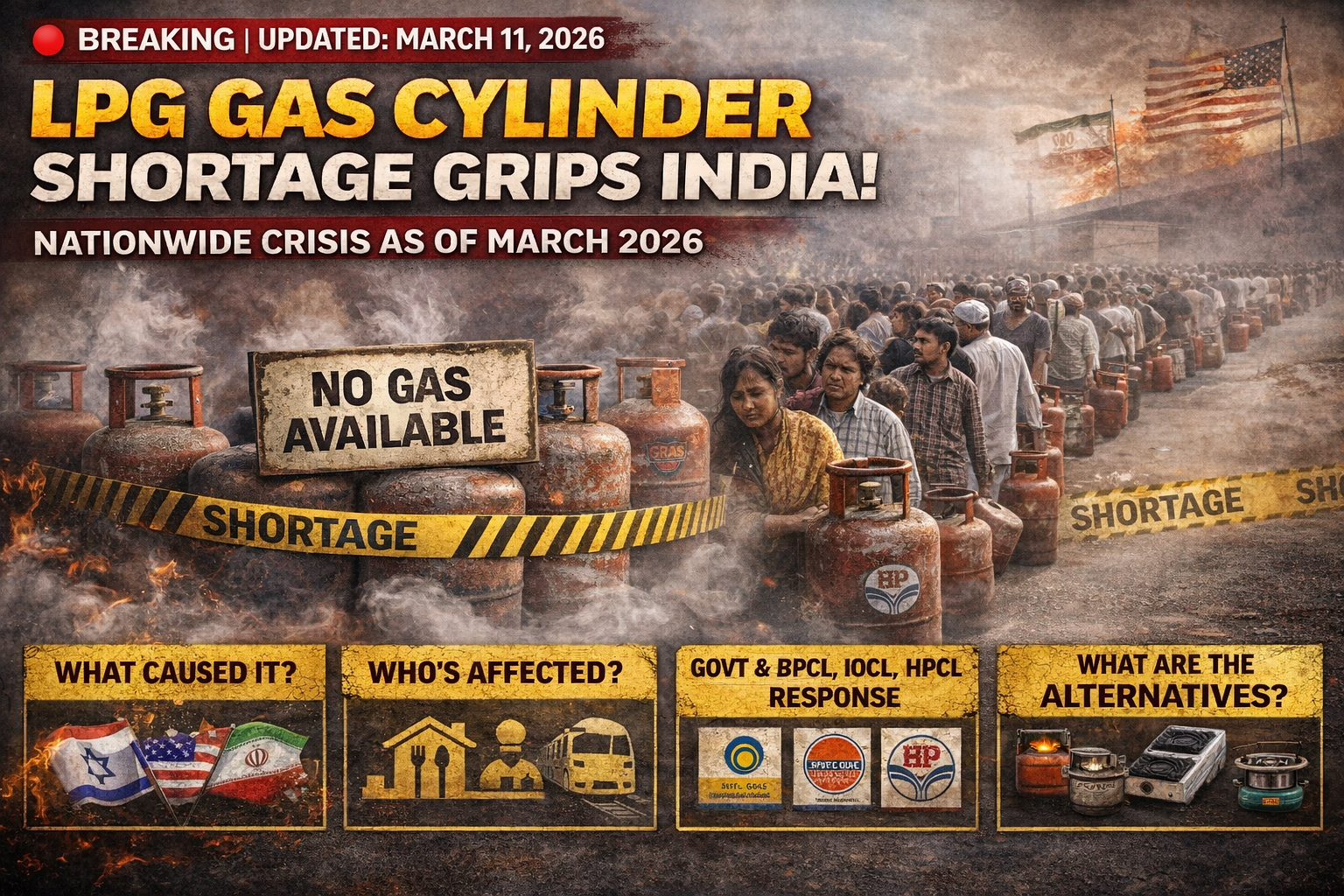
    India is in the grip of a serious LPG gas cylinder shortage that is disrupting kitchens, restaurants, railway catering, and households across the country. From Mumbai to Kolkata, Bengaluru to Chennai, and even hill towns like Darjeeling, the gas shortage in India triggered by the escalating Iran-Israel-US war has become a national concern as of March 2026.

    In this article, we break down everything you need to know — what caused it, who is affected, what BPCL, IOCL, and HPCL are doing, how IRCTC has responded, what the government’s priority order means for you, and what alternatives exist if your gas cylinder doesn’t arrive on time.

    🌍 What Caused the LPG Gas Cylinder Shortage in India?

    The root cause of the LPG crisis in India is a sharp disruption in global energy supply chains resulting from the US-Israel war against Iran in early 2026. The ongoing conflict has severely strained shipping through the Strait of Hormuz — a narrow passage between Iran and Oman through which a massive share of the world’s oil and gas flows.

    The military strikes from both sides have strained shipping through the Strait of Hormuz, a narrow passage between Iran and Oman that handles a significant share of global oil and gas trade. Several suppliers have also invoked force majeure clauses, legally excusing them from fulfilling their supply contracts due to the unforeseen conflict.

    India depends heavily on imported LPG to meet domestic demand as the country consumes about 31.3 million tonnes of LPG annually and imports roughly 62 per cent of that requirement, much of it passing through the Strait of Hormuz, a crucial global energy shipping route.

    This has triggered a domino effect — less imported gas arriving, oil companies unable to fill orders, distributors running dry, and restaurants, hotels, and households left scrambling for cylinders. Read: How much of India’s oil and LPG depends on the Strait of Hormuz? →

    ⛽ How Dependent Is India on Imported LPG?

    The numbers reveal just how exposed India is to this kind of shock. According to Outlook Business, India’s LPG imports ranged from about 1.83 million tonnes to 2.03 million tonnes per month from February 2025 to February 2026, with the bulk sourced from Gulf suppliers:

    • India consumes about 31.3 million tonnes of LPG annually, of which nearly 87 per cent is used in homes and the rest by commercial establishments such as hotels and restaurants. Around 62 per cent of the country’s LPG demand is met through imports.
    • A large share of these imports — around 85–90 per cent — traditionally arrives through the Strait of Hormuz from countries such as Saudi Arabia.
    • India is the world’s second-largest importer of LPG and consumed 31.3 million metric tons of LPG in the financial year 2025, according to a S&P Global report.
    • The NRAI represents over 500,000 restaurants across India. India’s industry generates an annual turnover of over 5.7 trillion rupees ($78.9 billion) and employs over 8 million people.

    Put simply, India’s LPG supply chain was heavily concentrated through a single maritime corridor — and the current conflict has effectively choked it. Read Business Standard’s full analysis on India’s LPG import vulnerability →

    🏛️ Government Response: Key Orders & Actions (March 2026)

    The Indian government has moved quickly, though the measures have directly caused the commercial gas cylinder shortage that restaurants and hotels are facing.

    1. Natural Gas (Supply Regulation) Order, 2026

    The government has issued the Natural Gas (Supply Regulation) Order, 2026 to control production, allocation and distribution of natural gas, including LNG and regasified LNG. The order said shipments have been disrupted through the Strait of Hormuz, prompting suppliers to invoke force majeure and divert gas to priority sectors.

    The government has now identified four priority sectors for natural gas allocation to prevent a cooking gas shortage and maintain critical services. These are:

    1. Priority 1: Piped natural gas for households (100% of past 6-month average)
    2. Priority 2: CNG for public transport vehicles
    3. Priority 3: LPG production and essential pipeline operations
    4. Priority 4: Industrial and commercial consumers via City Gas Distribution (CGD) networks (80% supply)

    2. Essential Commodities Act Invoked

    To manage the situation, the government has invoked provisions under the Essential Commodities Act (ECA) and the Essential Services Maintenance Act (ESMA) to prioritise domestic LPG supplies for households over commercial users. Refineries have been asked to operate at full capacity while directing additional production primarily toward household consumption.

    3. 25-Day Refill Booking Rule

    To prevent misuse and panic booking, the refill booking cycle for LPG cylinders has been increased from 21 days to 25 days. This is a significant change — previously, a refill could be booked within 48 hours in many cities.

    4. Price Hike

    The prices of non-subsidised domestic LPG cylinders were increased by ₹60, the first one since April last year. The price of commercial LPG was also raised by ₹114.5 per 19 kg cylinder.

    5. PM Modi’s Assurance

    Prime Minister Narendra Modi on Tuesday told the Cabinet that war should not impact the common man. Earlier, Union Petroleum Minister Hardeep Singh Puri met him amid reports of LPG cylinder shortage in several cities.

    6. Expanding Import Sources

    Government officials said India is in a better position compared to several other countries and is in regular contact with multiple nations to ensure that energy supplies continue without disruption. According to Business Standard, India increased its import of gas from non-Strait of Hormuz routes to 70 per cent from 55 per cent earlier.

    🛢️ BPCL, IOCL & HPCL: What India’s Oil Companies Are Doing

    India’s three major oil marketing companies — BPCL (Bharat Petroleum), IOCL (Indian Oil), and HPCL (Hindustan Petroleum) — have jointly responded to the crisis.

    In line with the Centre’s orders, state-run oil marketing companies — IOCL, BPCL, and HPCL — said they have taken steps to boost LPG production and prioritise its availability for domestic consumers and essential non-domestic sectors.

    The Centre also ordered all refineries to use their propane, butane, propylene, and butene output entirely for LPG production. Domestic producers have been directed to supply all LPG output to IOCL, BPCL, and HPCL, which together supply more than 99 per cent of India’s domestic LPG.

    Union Petroleum Minister Hardeep Singh Puri has established a three-member committee — comprising Executive Directors from IOC, HPCL, and BPCL — tasked with reviewing the grievances of restaurants, hotels, and catering associations.

    All refineries are operating at full capacity, and around 60 lakh cylinders are supplied across the country every day.

    📌 Key BPCL/OMC Actions Summary:
    ✅ LPG production increased by 10%
    ✅ All refinery propane/butane output diverted to LPG
    ✅ 3-member committee formed for commercial supply grievances
    ✅ Imports diversified away from Strait of Hormuz (now 70%)
    ✅ Violations to be penalised under Essential Commodities Act

    🚂 IRCTC Directive: Railway Catering Switches to Induction Cooking

    One of the most significant institutional responses to the LPG shortage in India came from Indian Railways’ catering arm — IRCTC.

    In a circular doing rounds on social media, released on March 10, 2026, IRCTC instructed all catering units in the West Zone to switch to alternative cooking methods, such as microwaves and induction cookers, in light of the ongoing shortage of LPG cylinders.

    As per the guidelines, these stations must also maintain an adequate stock of Ready-to-Eat (RTE) food items to ensure passenger demand is met. IRCTC emphasised that these measures are critical to ensuring that travellers have uninterrupted access to food during their journey.

    This move is intended to ensure that catering services remain unaffected as the crisis threatens to disrupt regular operations at Food Plazas, Refreshment Rooms (RR), and Jan Ahaars across Indian Railways.

    This could lead to a shortage of cooked meals nationwide and potential refunds for pre-booked passengers. If you have pre-booked meals on a long-distance train, check IRCTC’s app or website for updates on your order status.

    ⚠️ IRCTC Traveller Advisory: If you have a journey booked and had pre-ordered food, carry ready-to-eat snacks as a backup. Pantry car services may be limited at certain stations during the LPG crisis.

    🗺️ City-Wise Impact: Where Is the Gas Shortage Worst?

    📍 Mumbai

    According to the Hotel Owners Association of Mumbai (AAHAR), approximately 8,000 hotels in the city are affected by the crisis. The organisation claims that approximately 20 per cent of hotels have already closed, and if the supply of commercial gas cylinders does not return to normal in the next two to three days, approximately 4,000 to 5,000 more hotels could close.

    The ripple effects of the US-Israel strikes against Iran are now being felt in Mumbai, where citizens are now waiting two to eight days for refills of their domestic gas cylinders.

    📍 Bengaluru

    Distributors in Bengaluru said that although they currently have stock for the next four days, they have stopped supplies because oil companies did not refill commercial LPG cylinders. The price of a commercial cylinder in Bengaluru is currently ₹1,950 per cylinder. Reports have also emerged that some distributors are selling cylinders in the black market for up to ₹3,000.

    📍 Kolkata & West Bengal (including Darjeeling region)

    In Kolkata: Bakeries and restaurants are looking for alternatives after the Ministry suspended the distribution of Non-Domestic Non-Exempted Cylinders. The shortage has rippled across West Bengal, with the Darjeeling region’s tourism-heavy hospitality sector also at risk as hill restaurants and tea stalls depend almost entirely on commercial LPG cylinders.

    📍 Chennai & Tamil Nadu

    Nearly 10,000 establishments will shut down by Wednesday across India’s southernmost state, Tamil Nadu, M. Ravi, president of Chennai Hotel Association, told CNBC.

    The Sree Annapoorna Sree Gowrishankar Group, a Coimbatore-based prominent eatery chain, put out a notice on Monday night informing customers that it will limit its menu to essential items, and the availability of some items will be restricted to specific hours of the day.

    📍 Delhi-NCR

    A gas agency owner in Delhi said that commercial gas is not arriving, and therefore, they are unable to supply it. A notice has also been posted outside the gas agency stating that supplies of commercial cylinders to hotels, restaurants and other establishments have been discontinued.

    Black market prices in Delhi-NCR are reportedly as high as ₹1,500 for a domestic cylinder, as per local reports.

    📍 Hyderabad & Other Cities

    Hyderabad’s IT corridor hostels have reportedly begun facing breakfast disruptions, with some serving no dosa or puri bhaji due to the commercial gas cylinder shortage. Bhopal also witnessed a temporary halt in commercial LPG distribution, with only hospitals and educational institutions receiving supplies.

    🍽️ Commercial Gas Cylinder Crisis: Restaurants on the Brink

    The commercial gas cylinder crisis is at the heart of this emergency. Unlike domestic cylinders (14.2 kg), commercial cylinders are the larger 19 kg LPG cylinders used by restaurants, hotels, bakeries, catering services, and food businesses.

    The Ministry of Petroleum and Natural Gas said that it was directing oil refineries to prioritise supplying LPG to the 330 million households that use it as a primary cooking fuel, over 3 million businesses that use commercial LPG cylinders. This is causing a “crisis situation” that will lead to the closure of many restaurants over the next few days, Sagar Daryani, president of the National Restaurant Association of India, told CNBC. He added that 90% of restaurants in India rely on LPG cylinders to run their kitchens.

    Zorawar Kalra, restaurateur and vice-president of the NRAI, said the restaurant industry could face losses of around ₹1,200–1,300 crore per day if the disruption continues. He said that supplies of LPG cylinders are already tightening and nearly 70–75% of restaurants across India depend on LPG for their operations. [Source: BusinessToday — Full commercial LPG crisis explainer]

    City Status Hotels Affected
    Mumbai 🔴 Commercial supply halted ~8,000 affected; 20% shut
    Bengaluru 🔴 Supply stopped; black market active Industry on brink; CM wrote to Centre
    Kolkata 🔴 Non-domestic supply suspended Bakeries & restaurants seeking alternatives
    Chennai / TN 🔴 Critical; 5 lakh cylinders halted ~10,000 establishments at risk of closure
    Delhi-NCR 🟠 Commercial halted; domestic delayed Agencies posting “no supply” notices
    Hyderabad 🟠 Shortage reported in IT corridor Hostels affected; no breakfast items
    Darjeeling / WB hills 🟠 Supply tightening Tourism sector & tea stalls at risk

    🏠 What About Your Home Gas Cylinder? (Domestic LPG Update)

    The government has made it clear that domestic LPG cylinders are the top priority. However, households are still feeling the pinch:

    • Domestic cylinders are facing delivery delays of two to eight days after booking.
    • The refill booking window has been extended to 25 days (from 21), meaning you can only re-book after 25 days from your last booking.
    • Government officials said there is no need to panic as authorities are actively working to meet the country’s oil and energy requirements.
    • Hospitals and educational institutions continue to receive priority supply of imported LPG even under the crisis.
    Government’s official position (March 11, 2026): “India remains in a comfortable position on LPG supplies.” Domestic users are protected under Priority Sector 1 and will receive 100% of their average consumption.

    🔌 Alternatives to LPG During the Gas Shortage

    With the LPG cylinder supply uncertain, many households and businesses are switching to electric alternatives. Here’s what’s working:

    1. Induction Cooktops

    Sales of induction cookers are increasing rapidly following news of an LPG shortage. According to the US Department of Energy, induction cookers heat up cookware much better than other methods — water can be brought to a boil up to 40% faster on induction cookers than on gas.

    2. Microwave Ovens

    IRCTC’s switch to microwave-based cooking at railway stations demonstrates that microwaves are a viable short-term alternative for heating and basic cooking, especially with Ready-to-Eat meals.

    3. Electric Pressure Cookers & Rice Cookers

    Apart from induction stoves, other appliances such as electric kettles, microwave ovens and electric rice cookers are also witnessing higher demand in several stores.

    4. Piped Natural Gas (PNG) — Unaffected

    If your home or business is connected to a piped natural gas network (such as GAIL’s infrastructure), you are currently unaffected. PNG household connections are Priority Sector 1 under the government’s order and continue to receive full supply.

    💡 Practical Tips for Households:
    • Book your LPG refill as soon as you cross 25 days from the last booking
    • Avoid panic-buying or over-booking (it’s being monitored)
    • Use pressure cookers to reduce gas consumption by up to 70%
    • Consider buying an induction cooktop as a backup
    • Avoid long-duration cooking; opt for quick one-pot meals

    ❓ Frequently Asked Questions About LPG Shortage in India

    Why is there a gas cylinder shortage in India in 2026?

    The gas cylinder shortage in India is caused by disruptions to global LPG supply chains following the US-Israel-Iran conflict in West Asia. The Strait of Hormuz — through which India imports 85–90% of its LPG — has been severely disrupted, leading to supply delays and the government prioritising domestic household supply over commercial users.

    Is there an LPG shortage in my city?

    As of March 11, 2026, the worst-affected cities for commercial gas cylinder supply are Mumbai, Bengaluru, Kolkata, Chennai, Delhi, and Hyderabad. Domestic household supply is being maintained, but delays of 2–8 days are common. Hill stations like Darjeeling in West Bengal are also reporting supply tightening.

    What is the new LPG booking rule?

    The government has extended the minimum gap between LPG refill bookings from 21 days to 25 days. You can only re-book your gas cylinder 25 days after your last booking to prevent hoarding and panic buying.

    What is BPCL doing about the LPG shortage?

    BPCL, along with IOCL and HPCL, has directed refineries to maximize LPG output, diverting all propane and butane production to LPG. A three-member committee of Executive Directors from these companies has been set up to review commercial supply grievances from hotel and restaurant associations.

    What did IRCTC say about the LPG crisis?

    IRCTC issued a directive on March 10, 2026, instructing catering units in its West Zone to switch from LPG cooking to electric induction stoves and microwave ovens. Railway food plazas, refreshment rooms, and Jan Aahar outlets are affected. IRCTC has also asked units to stock Ready-to-Eat items to ensure passengers continue to receive food service.

    Will LPG prices increase further?

    Domestic LPG prices have already been hiked by ₹60 per cylinder, while commercial cylinders went up by ₹114.5 per 19 kg cylinder in early March 2026. Further hikes will depend on how long the West Asia conflict continues and whether alternative supply routes can be scaled up.

    What is the LPG shortage situation in Darjeeling?

    Darjeeling, being part of West Bengal, is experiencing the indirect impact of the gas shortage in India. The region’s tourism-driven hospitality sector — restaurants, tea houses, and hotels — depends heavily on commercial LPG cylinders. With Kolkata distribution disrupted, supply to hill regions including Darjeeling has tightened considerably.

    When will the LPG shortage end?

    Industry officials say the shortage may not last long. Government authorities and oil companies are exploring alternative supply routes and working to secure additional shipments to stabilise availability. The government projects faster normalisation once the regional conflict stabilises and new LPG shipments via non-Hormuz routes begin arriving.

    📌 What to Do Right Now

    If you’re a household: Don’t panic. Book your refill when eligible (25-day rule), switch to induction as backup, and conserve gas by using pressure cookers and one-pot meals.

    If you’re a restaurant or hotel owner: Register your grievance with the committee of EDs from BPCL, IOCL, and HPCL via your local OMC office. Consider temporary switches to induction cooking or electric cooking equipment. The government has stated that the genuine requirements of restaurants will be reviewed and addressed.

    If you’re an IRCTC traveller: Carry backup snacks. Food plazas at some stations may have a limited menu. Track your e-catering orders via the IRCTC app.

    🔔 Bookmark this page for updates. We are tracking the LPG gas cylinder shortage in India closely and will update this article as the situation develops. Share this with friends and family so they know what to do. 🙏

    Bookmark LifeHackHub for more such updates
  • Women in Islam: What Islam Gave Women 1,400 Years Before Feminism Did

    Women in Islam: What Islam Gave Women 1,400 Years Before Feminism Did

    Discover the true status of women in Islam — property rights, divorce, inheritance & more — granted 1,400 years before modern feminism. A must-read this Women’s Day 2026.

    Every year on March 8, the world pauses to celebrate International Women’s Day — a day born out of decades of feminist struggle for rights that women were long denied. Equal pay. The right to vote. The right to own property. The right to say no.

    These are real, hard-won victories. No one disputes that.

    But here is a question that rarely gets asked on this day:

    “What if women in Islam already had many of these rights — living in 7th century Arabia, more than 1,000 years before Western women did?”

    If that surprises you, you’re not alone. The true status of women in Islam is one of the most misunderstood and misrepresented subjects in modern discourse. This International Women’s Day 2026, let’s look at it honestly — not through headlines, but through history.

    ⚠️ Women in Islam vs. The Ancient World: What Came Before?

    To understand what Islam gave women, you first need to understand what the world looked like before it.

    In pre-Islamic Arabia (known as the Jahiliyyah, or Age of Ignorance), the birth of a daughter was considered a disgrace. Female infanticide — burying newborn girls alive — was common practice. Women were inherited like property when a man died. They had no right to refuse marriage, no right to divorce, no right to inheritance, and no legal identity of their own.

    But Arabia wasn’t alone. Consider:

    Now compare this timeline to what Islam established in 622 CE.

    🕌 Rights of Women in Islam — Granted Over 1,400 Years Ago

    The rights granted to women in Islam were not gradual reforms won through protest. They were divine mandates, established at the very founding of the religion. Here are the most significant rights Islam gave women — and when the West finally caught up:

    1. The Right to Own Property

    Islam gave women the full, unconditional right to own, manage, and dispose of property — independently of their husbands or fathers. This was enshrined in the Quran (Surah An-Nisa, 4:32). British women wouldn’t get this right until the Married Women’s Property Act of 1882 — over 1,200 years later.

    2. The Right to Inheritance

    The Quran explicitly grants women the right to inherit from parents, husbands, and children (Surah An-Nisa, 4:11-12). In most of the ancient world, women were entirely excluded from inheritance. Islam made it a legal obligation.

    3. The Right to Choose Their Spouse

    Islamic law requires the full, free consent of a woman for a marriage to be valid. The Prophet Muhammad (ﷺ) explicitly stated: “A previously married woman may not be given in marriage without her clear consent, and a virgin may not be given in marriage without her permission.” (Sahih Bukhari). A forced marriage in Islam is legally void.

    4. The Right to Divorce

    While the husband has talaq (the right to pronounce divorce), Islamic law also grants women khul’ — the right to seek and obtain a divorce from the courts. This was revolutionary. In most Western legal systems, women couldn’t file for divorce independently until the 19th and 20th centuries.

    5. Financial Security — Not Financial Burden

    In Islam, a woman is never financially responsible for the household — even if she is wealthy. That obligation falls entirely on the husband. He is required to provide mahr (a mandatory gift of money or property to the wife at marriage), maintain her living expenses, and support the children. A woman’s income, earnings, and assets are entirely her own to keep.

    6. The Right to Education

    The Prophet Muhammad (ﷺ) said: “Seeking knowledge is an obligation upon every Muslim.” — with no gender distinction. Women in early Islamic history were prominent scholars, jurists, and teachers. Aisha (RA), the Prophet’s wife, is cited over 2,000 times in Islamic jurisprudence and was one of the greatest scholars of her era.

    7. Legal Identity & Personhood

    Under Islamic law, a woman retains her full legal identity after marriage. She keeps her family name, her financial assets, and her independent legal standing. In contrast, under English common law, a woman’s legal identity was literally absorbed into her husband’s upon marriage — a doctrine called coverture — until the late 1800s.

    ⚖️ Women in Islam vs the Modern Feminist Movement: A Side-by-Side Comparison

    Right / Issue Islam (Est. ~622 CE) Western Law / Feminism
    Right to own property ✅ 622 CE UK: 1882 | USA: varies by state
    Right to inheritance ✅ 622 CE Widely restricted until 19th century
    Consent required for marriage ✅ 622 CE Not legally enforced in most of Europe until 20th century
    Right to divorce ✅ 622 CE (khul’) UK: 1857 | USA: late 19th century
    Retain own name after marriage ✅ Always Still not universal; socially pressured
    Financial maintenance by husband ✅ Mandatory in Islam Not guaranteed; both partners often required to contribute
    Right to education ✅ 622 CE (religious obligation) Women barred from universities in most of Europe until 19th century
    Legal identity independent of husband ✅ Always UK coverture abolished: 1882
    Right to vote ⚠️ Not part of Islamic framework (Shura applies to all) UK: 1918 | USA: 1920

    The pattern is striking. In area after area, Islamic law was centuries ahead of the societies that would later champion women’s rights through feminist movements.

    🤔 Common Questions About Women in Islam — Answered Honestly

    A fair comparison requires addressing the questions that naturally arise. Here are three of the most commonly raised concerns — answered honestly.

    ❓ “Doesn’t Islam allow polygamy?”

    Islam permits a man to marry up to four wives — but with strict, often overlooked conditions. The Quran (Surah An-Nisa, 4:3) states this is only permissible if the husband can treat all wives with complete equality and justice, and immediately adds: “But if you fear that you will not be just, then marry only one.” Most Islamic scholars consider this an implicit discouragement. It’s also worth noting that polygamy was already widespread in pre-Islamic Arabia — Islam didn’t introduce it, it regulated and limited it, and gave each wife full legal rights within the arrangement.

    ❓ “Don’t women inherit less than men?”

    In most cases under Islamic inheritance law, a daughter inherits half the share of a son. This is often cited as inequality — but the full picture matters. Under the same Islamic law, a son is legally obligated to financially support the family, while a daughter keeps her inheritance entirely for herself with no such obligation. The difference in share reflects a difference in financial responsibility — not a statement of lesser worth. Many contemporary Islamic scholars continue to debate and discuss how these principles apply in modern contexts.

    ❓ “What about the hijab — isn’t it oppressive?”

    This is perhaps the most debated question of all. What is rarely acknowledged is that many Muslim women who wear the hijab describe it not as a restriction, but as liberation from being judged by appearance — a freedom to be seen for their intellect, character, and contributions rather than their body. At the same time, the forced imposition of hijab by any government or individual is widely condemned by Islamic scholars as contrary to the Quranic principle: “There is no compulsion in religion” (2:256). The difference between choice and compulsion is everything — and that distinction exists within Islam itself.

    🌍 Women in Islam Today & International Women’s Day 2026

    It would be dishonest to discuss this topic without acknowledging reality: in many parts of the Muslim world today, women face very real injustice — denied education, forced into marriages, stripped of legal protections they are entitled to under Islam itself. This is a genuine problem that Muslim communities must confront.

    But here is a crucial distinction that often gets lost: the gap between Islamic law and the practices of some Muslim-majority societies is not evidence against Islam — it is evidence of those societies failing to live up to it.

    Many of the injustices faced by women in some Muslim-majority countries stem from pre-Islamic tribal customs, cultural patriarchy, and political authoritarianism — not from the Quran or the Sunnah. Muslim women scholars, activists, and reformers around the world make exactly this argument: that the path forward for Muslim women runs through Islamic principles, not away from them.

    On International Women’s Day 2026, it is worth recognising that the struggle for women’s dignity is universal — and that Islam, properly understood and properly practised, is not the obstacle to that dignity. It may, in many ways, be one of its oldest foundations.

    💬 Final Thought: What Women in Islam Can Teach the World

    Modern feminism has achieved extraordinary things. The right to vote, to work, to be heard, to be safe — these victories belong to everyone and deserve celebration.

    But perhaps this International Women’s Day, we can also make room for a more nuanced question: What does it mean that a 7th-century religion gave women rights that the most “advanced” civilisations of Europe didn’t recognise until the 20th century?

    You don’t have to be Muslim to find that worth thinking about.

    And if it makes you even a little curious about what Islam actually says — not what people assume it says, not what authoritarian governments claim it says, but what the texts themselves say — then this Women’s Day may have opened a door worth walking through.

    💬 What do you think? Did any of these historical facts surprise you? Share your thoughts in the comments — we’d love to hear from you. And if this post made you think, share it with someone who might find it thought-provoking too. 🌿

    ❓ Frequently Asked Questions About Women in Islam

    What rights did Islam give women?

    Islam granted women the right to own and manage property, the right to inheritance, the right to consent to or refuse marriage, the right to seek divorce (khul’), the right to education, and full legal identity independent of their husband — all established in the 7th century CE.

    How does Islam view women?

    Islam views women as spiritually equal to men. The Quran states: “Whoever does righteous deeds, whether male or female, while being a believer — We will grant them a good life.” (16:97). Women are honoured as daughters, wives, mothers, and scholars in Islamic tradition.

    What is the status of women in Islam compared to the West?

    Historically, Islamic law granted women rights — such as property ownership, inheritance, and consent in marriage — many centuries before Western legal systems did. The Married Women’s Property Act in the UK, for example, was passed in 1882, while Islam established women’s property rights in 622 CE.

    Does Islam support women’s rights?

    Islamic law, as derived from the Quran and Hadith, grants women extensive rights in marriage, divorce, property, inheritance, and education. Many scholars argue that where women’s rights are violated in Muslim-majority societies, it is due to cultural practices and political failures rather than Islamic teaching itself.

    What is International Women’s Day and when is it in 2026?

    International Women’s Day is observed every year on March 8 to celebrate women’s achievements and advocate for gender equality. In 2026, it falls on Sunday, 8 March 2026.


    Bookmark for more update: LifeHackHub

  • Happy Women’s Day 2026: Best Wishes, Quotes & Messages

    Happy Women’s Day 2026: Best Wishes, Quotes & Messages

    Every year on March 8, the world comes together to celebrate International Women’s Day — a day to honour the strength, resilience, and achievements of women everywhere. Whether you’re looking for Happy Women’s Day 2026 wishes, heartfelt Women’s Day quotes, or the perfect Women’s Day message for someone special, you’ve come to the right place.

    In this post, we’ve compiled the most beautiful and unique Women’s Day wishes for 2026 — for your wife, mother, girlfriend, colleagues, and all the wonderful ladies in your life. 💜

    📅 When Is Women’s Day 2026?

    International Women’s Day 2026 falls on Sunday, March 8, 2026. It is observed every year on 8 March globally, including in India, to celebrate women’s social, economic, cultural, and political achievements.

    📌 Women’s Day Date 2026: Sunday, 8 March 2026

    🎨 Women’s Day 2026 Theme

    The official International Women’s Day 2026 theme is “Accelerate Action” — urging faster progress toward gender equality. The theme is a call to action for individuals, governments, and organizations to speed up the pace of change for women worldwide.

    💐 Happy Women’s Day 2026 Wishes

    Share these warm and inspiring Women’s Day 2026 wishes with the special women in your life:

    1. Wishing you a very Happy Women’s Day 2026! You are a source of inspiration to everyone around you. May this day remind you of your incredible worth. 💜
    2. On this special day, I want to remind you how powerful, beautiful, and irreplaceable you are. Happy International Women’s Day!
    3. To every woman who keeps going despite the challenges — you are a true warrior. Happy Women’s Day 2026!
    4. May this Women’s Day bring you joy, recognition, and all the love you deserve. You make the world a better place simply by being in it. 🌸
    5. Here’s to women — the dreamers, the doers, the caregivers, and the changemakers. Happy Women’s Day!
    6. You carry grace in your heart and strength in your soul. Wishing you a wonderful Happy Women’s Day 2026!
    7. Today and every day, your efforts deserve to be celebrated. Happy International Women’s Day 2026! 🌺
    8. The world is a brighter place because of the light you carry. Happy Women’s Day to you!

    ✨ Women’s Day Quotes in English (2026)

    Here are some of the most unique and inspiring Women’s Day quotes to share on social media, WhatsApp, or as a Women’s Day status:

    “A woman is the full circle. Within her is the power to create, nurture and transform.” — Diane Mariechild
    “Here’s to strong women — may we know them, may we be them, may we raise them.” — Unknown
    “A woman with a voice is, by definition, a strong woman.” — Melinda Gates
    “Women are the real architects of society.” — Harriet Beecher Stowe
    “She believed she could, so she did.” — R.S. Grey
    “The most courageous act is still to think for yourself. Aloud.” — Coco Chanel

    💍 Women’s Day Wishes for Wife

    Looking for the perfect Women’s Day wishes for your wife? These heartfelt messages will show her just how much she means to you:

    1. My love, you are my strength, my peace, and my greatest blessing. Happy Women’s Day to my beautiful wife! 💍
    2. Every day I thank my stars for a woman like you by my side. Wishing you a very Happy Women’s Day 2026!
    3. You manage this home, our family, and still find time to shine in everything you do. You are extraordinary. Happy Women’s Day, darling! 🌹
    4. To my wife — the woman who makes every day feel like a celebration. Happy International Women’s Day! I love you endlessly.
    5. You are not just my wife — you are my partner, my best friend, and my hero. Happy Women’s Day to my forever person. 💜

    👩‍👧 Women’s Day Wishes for Mother

    Send these touching Women’s Day wishes for mother to the woman who gave you everything:

    1. Maa, you are the strongest woman I know. No words are enough to describe your love. Happy Women’s Day! 🌸
    2. You have been my first teacher, my safe place, and my biggest support. Happy International Women’s Day, Mom!
    3. Everything I am today is because of you. Thank you for your endless sacrifices. Happy Women’s Day 2026! 💐
    4. The world may celebrate women today, but I celebrate you every single day. Happy Women’s Day, Maa!
    5. A mother’s love is the purest force in the universe. You are proof of that. Wishing you a joyful Women’s Day!

    💕 Women’s Day Wishes for Girlfriend

    Make her smile with these sweet Women’s Day wishes for your girlfriend:

    1. You are my sunshine on cloudy days and my calm in every storm. Happy Women’s Day, my love! 💕
    2. Being with you makes me realize what it means to have a truly remarkable person by your side. Happy Women’s Day 2026!
    3. To the girl who has my heart — you deserve all the happiness in the world today and always. 🌺 Happy Women’s Day!
    4. You are fierce, funny, kind, and endlessly beautiful. Happy International Women’s Day to the woman who completes me.
    5. This day was made for women like you — extraordinary in every way. Happy Women’s Day, beautiful! 💜

    🌸 Women’s Day Wishes for All Ladies

    Share these Women’s Day wishes for all ladies — colleagues, friends, sisters, and every woman who deserves appreciation:

    1. Happy Women’s Day to every woman reading this — you are seen, you are valued, and you are celebrated! 🙌
    2. To all the incredible women out there juggling a thousand things with a smile — this day is for you. Happy International Women’s Day 2026!
    3. The world runs on the love, labor, and laughter of women. Happy Women’s Day to all ladies! 🌸
    4. May this Women’s Day remind every woman of her worth and her power. You are unstoppable! 💜
    5. Happy Women’s Day 2026 to every woman who chose courage over comfort and kindness over everything.

    📸 Women’s Day Captions for Instagram & WhatsApp Status

    Use these catchy Women’s Day captions and status for your social media posts:

    • She’s a storm wrapped in grace. 🌪️💜 #HappyWomensDay2026
    • Not just a day. A movement. A revolution. #InternationalWomensDay
    • Empowered women empower women. 💪 #WomensDay2026
    • To every woman — you are the reason the world keeps going. 🌺
    • Happy 8 March! Today belongs to you. 🌸 #March8 #WomensDay
    • Bold. Beautiful. Unstoppable. That’s YOU. 💜 #HappyWomensDay
    • Girls support girls. Women lift women. 🙌 #WomensDay2026India

    ⚡ Women’s Day Quotes One Liners

    Perfect for quick Women’s Day quotes one liners to use on cards, texts, or stories:

    • “She’s not just a woman. She’s a world.” 🌍
    • “Behind every great anything is a woman.” 💜
    • “Her strength is unmatched. Her heart, unparalleled.”
    • “Soft enough to care. Strong enough to change the world.”
    • “A woman’s power isn’t given — it’s earned.” ✊
    • “She turns pain into power and setbacks into comebacks.” 🔥
    • “Women: proof that grace and grit can coexist.” 🌸
    • “Not fragile like a flower. Fragile like a bomb. 💣” — R.H. Sin

    ❓ Frequently Asked Questions About Women’s Day 2026

    When is Women’s Day 2026?

    International Women’s Day 2026 is on Sunday, 8 March 2026. It is observed annually on March 8 across the world.

    Is today Women’s Day?

    If today is March 8, then yes — today is International Women’s Day! It is celebrated every year on 8 March globally.

    What is the Women’s Day 2026 theme?

    The Women’s Day 2026 theme is “Accelerate Action” — calling on everyone to move faster toward gender equality and women’s empowerment.

    What is the Women’s Day 2026 theme in India?

    In India, Women’s Day 2026 is celebrated on 8 March with events, cultural programs, and government initiatives. The theme aligns with the global theme of “Accelerate Action”.

    What is International Women’s Day?

    International Women’s Day (IWD) is a global celebration observed on March 8 every year. It honours women’s social, economic, cultural, and political achievements while calling for gender equality. The day has been recognized by the United Nations since 1977.

    What is the colour of Women’s Day 2026?

    The traditional colours associated with International Women’s Day are purple, green, and white — symbolising dignity, hope, and purity respectively.

    💌 Wrap Up: Celebrate Every Woman Today

    This Women’s Day 2026, take a moment to reach out to the women who matter most in your life. A simple wish, a heartfelt message, or even a warm hug can go a long way in making someone feel truly celebrated.

    Whether it’s your mother, wife, girlfriend, sister, colleague, or friend — let her know she is seen, appreciated, and loved. Happy International Women’s Day 2026! 💜🌸

    💜 Share this post with every woman who deserves to feel special today! 💜
    Click on Image to Purchase the item

    Bookmark for more update: LifeHackHub

  • Finn Allen’s Fastest Century in T20 World Cup History: Everything You Need to Know

    Finn Allen’s Fastest Century in T20 World Cup History: Everything You Need to Know

    Finn Allen Scores the Fastest Century in T20 World Cup History

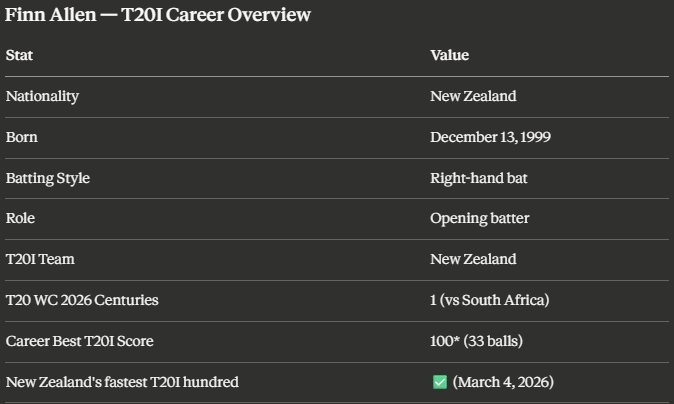
    On March 4, 2026, at Eden Gardens, Kolkata, New Zealand opener Finn Allen rewrote cricket history by smashing the fastest century ever recorded in a T20 World Cup — off just 33 balls — against South Africa in the T20 World Cup 2026 semi-final.

    Not only did Allen break the T20 World Cup record, but his hundred also set several additional milestones simultaneously:

    • ✅ Fastest T20 World Cup century (33 balls) — any format, any World Cup
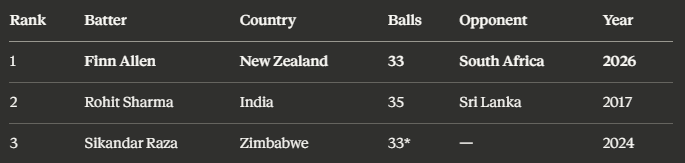
    • ✅ Broke Rohit Sharma’s record for the fastest T20I century by a full-member nation batter (35 balls vs Sri Lanka, 2017)
    • ✅ Joint third-fastest T20I century of all time (across all international cricket)
    • ✅ Fastest T20I century by any batter against a full-member nation
    • ✅ New Zealand’s fastest ever T20I century (surpassing Glenn Phillips’ 46-ball effort vs West Indies, 2020)

    Finn Allen’s Record Innings — Ball by Ball Breakdown

    Allen finished with 100 not out off 33 balls, with a strike rate of 303.03. He hit 10 fours and 8 sixes — the joint highest boundary count in a T20 World Cup innings alongside Brendon McCullum’s legendary 123 vs Bangladesh in 2012.

    The pivotal moment came in the 13th over of New Zealand’s chase. With 21 needed to win, Allen launched a ferocious assault on Marco Jansen: four, four, six, six, four — sealing the win and his century in the same delivery, a boundary over mid-off that stunned the Proteas and electrified Eden Gardens.

    Allen’s record surpassed both formats — T20 and ODI World Cups — breaking Glenn Maxwell’s 40-ball ODI World Cup century (vs Netherlands, 2023)

    Fastest T20I Centuries of All Time — Full Member Nations

    Finn Allen’s century is also historic in the wider T20I context:

    Note: The overall fastest T20I century (all nations) is held by Sahil Chauhan of Estonia — 27 balls vs Cyprus in 2024. However, this was against an associate member nation. Allen’s is the fastest against a full ICC member.

    How Finn Allen Broke Rohit Sharma’s 9-Year Record

    Former India captain Rohit Sharma held the record for the fastest T20I century by a full-member nation batter for 9 years — a 35-ball blitz against Sri Lanka in 2017. Rohit’s record was considered one of the most untouchable in T20 cricket.

    Allen eclipsed it with a 33-ball effort, and did so on the grandest possible stage — a World Cup semi-final, chasing, against one of the tournament’s form sides. Whereas Rohit’s record came in a bilateral series, Allen’s came under maximum pressure at Eden Gardens with 60,000 fans watching.

    Allen is one of New Zealand’s most explosive batters. He joins Brendon McCullum and Glenn Phillips as New Zealanders to score a century at a T20 World Cup.

    How This Century Compares to Other Legendary T20 Knocks

    vs Brendon McCullum — 123 vs Bangladesh (T20 WC 2012) McCullum’s century in 56 balls in the inaugural tournament is a legend of the game. Allen was nearly twice as fast, but McCullum’s innings was in a different era of T20 cricket.

    vs Chris Gayle — 100 vs England (T20 WC 2016) Gayle held the T20 World Cup record (47 balls) for a decade. Allen demolished it by 14 balls.

    vs Glenn Maxwell — 40-ball ODI WC century (2023) Allen’s 33-ball hundred is now the fastest century in World Cup cricket history across all formats, beating Maxwell’s ODI effort.

    What Makes Allen’s Innings So Remarkable

    The stage: A World Cup semi-final. Not a bilateral series. Not a warm-up. A knockout match with everything at stake.

    The opponent: South Africa were unbeaten in the tournament and one of the most feared bowling attacks, featuring Kagiso Rabada, Lungi Ngidi, and Marco Jansen.

    The method: 10 fours and 8 sixes. Not slogging — clean, precise hitting to all parts of the ground.

    The timing: He completed his century and the winning runs in the same shot. Drama doesn’t come bigger than that.

    The result: New Zealand won by 9 wickets with 43 balls to spare — one of the most comprehensive semi-final victories in T20 World Cup history.

    Glenn Phillips’ Previous NZ Record

    The previous New Zealand record for a T20I century was held by Glenn Phillips, who scored a century in 46 balls against the West Indies in 2020. Allen obliterated that record by 13 balls. Phillips himself scored a T20 World Cup century in 2022 against Sri Lanka.

    Q: What is the fastest century in T20 World Cup history?

    A: Finn Allen’s 33-ball century vs South Africa in the 2026 T20 World Cup semi-final is the fastest in tournament history.

    Q: What is the fastest T20I century ever?

    A: The fastest T20I century overall is 27 balls by Sahil Chauhan of Estonia vs Cyprus in 2024. Among full-member nations, Finn Allen’s 33-ball effort (2026) is the fastest.

    Q: Whose record did Finn Allen break?

    A: Allen broke Rohit Sharma’s record of 35 balls (vs Sri Lanka, 2017) for the fastest T20I century by a full-member nation batter, and Chris Gayle’s 47-ball effort for the fastest century in T20 World Cup history.

    Q: How many sixes did Finn Allen hit vs South Africa?

    A: Finn Allen hit 8 sixes and 10 fours in his 100 not out off 33 balls.

    Q: Is this the fastest century in ODI World Cup history too?

    A: Yes. Allen’s 33-ball hundred also surpassed Glenn Maxwell’s 40-ball ODI World Cup century (2023), making it the fastest century in World Cup history across both T20 and ODI formats.


    Bookmark LifeHackHub for more updates

  • T20 World Cup 2026: Schedule, Teams, Venues

    T20 World Cup 2026: Schedule, Teams, Venues

    Introduction

    The ICC Men’s T20 World Cup 2026 is cricket’s biggest stage — and it’s happening right now. Co-hosted by India and Sri Lanka, the tenth edition of the tournament runs from February 7 to March 8, 2026, featuring 20 nations, 55 matches, and some of the most explosive cricket ever witnessed.
    With the semi-finals now confirmed, cricket fans worldwide are locked in. Here’s your complete guide.

    Tournament Overview

    • Edition: 10th ICC Men’s T20 World Cup
    • Dates: February 7 – March 8, 2026
    • Host Nations: India & Sri Lanka
    • Total Teams: 20
    • Total Matches: 55
    • Defending Champions: India
    • First-time Qualifier: Italy

    Venues

    India

    • Narendra Modi Stadium, Ahmedabad (Final venue — 132,000 capacity)
    • Eden Gardens, Kolkata (Semi-Final 1)
    • Wankhede Stadium, Mumbai (Semi-Final 2)
    • M.A. Chidambaram Stadium, Chennai
    • DY Patil Stadium, Navi Mumbai

    Sri Lanka

    Semi-Final Schedule

    Semi-Final 1South Africa vs New Zealand | March 4, 2026 | Eden Gardens, Kolkata
    Semi-Final 2India vs England | March 5, 2026 | Wankhede Stadium, Mumbai
    FinalTBD | March 8, 2026 | Narendra Modi Stadium, Ahmedabad

    Key Teams to Watch

    India — Defending Champions

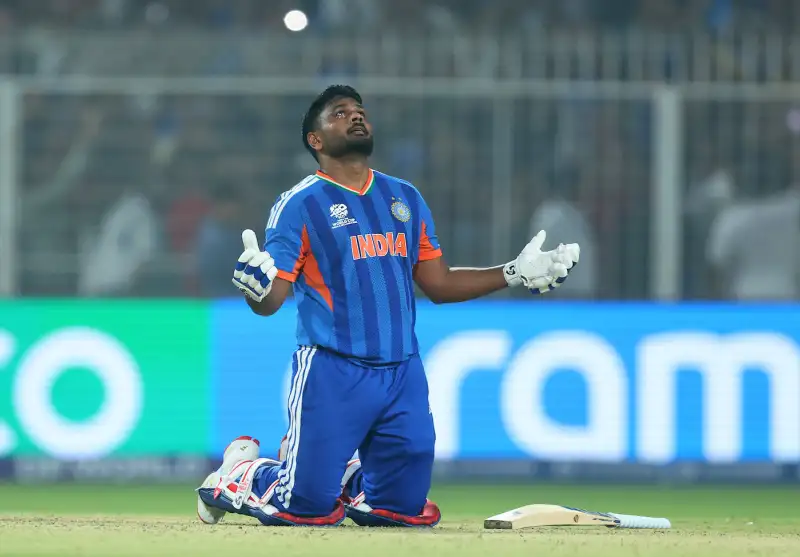
    India enter the semis in electric form. Sanju Samson’s stunning unbeaten 97 vs West Indies in the Super 8 clinched their spot in the last four. As ICC’s top-ranked T20 team with both the top batter and top bowler in their ranks, India are firm favourites to lift the trophy at home.

    South Africa — The Unbeaten Threat

    South Africa are the only undefeated team in this tournament. The Proteas, determined to avenge their agonising 7-run final loss in the previous edition, have two batters in the top run-scorers list and three bowlers in the top wicket-takers — a truly dominant campaign.

    England — The Dangerous Outsiders

    England secured their semi-final spot with three wins in the Super 8 stage. With Jofra Archer back in the mix, they pose a genuine threat to India on March 5 in Mumbai.

    New Zealand — The Quiet Achievers

    New Zealand quietly navigated the group stage and Super 8s. Captain Mitchell Santner brings calm leadership, and the team is well-drilled for knockout pressure.

    Notable Records & Moments

    • Rashid Khan (Afghanistan) took his 700th T20 wicket — the first cricketer in history to reach this milestone.
    • Yuvraj Samra (Canada) became the youngest player and first player from an Associate nation to score a century in T20 World Cup history.
    • Italy qualified for the Men’s T20 World Cup for the first time ever.
    • Bangladesh withdrew; Scotland replaced them as the next highest-ranked T20I team.

    Q: Where is the T20 World Cup 2026 final?

    A: The final is scheduled for March 8, 2026, at Narendra Modi Stadium in Ahmedabad, India — the world’s largest cricket stadium with a capacity of 132,000.

    Q: Who are the four semi-finalists in T20 World Cup 2026?

    A: The four semi-finalists are India, England, South Africa, and New Zealand.

    Q: Who is defending champion in T20 World Cup 2026?Who are the four semi-finalists in T20 World Cup 2026?

    A: India are the defending champions heading into the 2026 tournament.

    Q: How many teams are in T20 World Cup 2026?

    A: 20 teams are competing across 55 matches in the 2026 edition.


    Bookmark Lifehackhub for more updates

  • Is Netanyahu Alive? Latest Update on Israel’s Prime Minister

    Is Netanyahu Alive? Latest Update on Israel’s Prime Minister

    A wave of viral rumors in early March 2026 asked, “Is Netanyahu alive?” and “Is Netanyahu dead?” as unverified claims about his death flooded social‑media timelines. However, these reports have been officially dismissed; Israeli authorities and international media confirm that Benjamin Netanyahu is alive and continues to serve as Prime Minister of Israel.

    What Happened to Netanyahu in 2026?

    False rumors claiming “Netanyahu killed” or “Netanyahu death” began after Iranian‑linked sources alleged that Netanyahu’s office in Tel Aviv had been targeted in a missile strike. The Islamic Revolutionary Guard Corps (IRGC) reportedly stated his fate was “unclear,” which fueled speculation that “Netanyahu is dead.”

    However, Netanyahu’s office and several international outlets quickly labeled these claims as fake news, pointing out that there was no credible evidence of his death and that Netanyahu was still appearing in public and making official statements. In fact, Netanyahu was seen on video on March 1–2, 2026, vowing to intensify Israeli strikes on Iran and addressing the nation about the ongoing conflict.

    Netanyahu’s Current Role and Recent Netanyahu News

    As of early 2026, Benjamin Netanyahu remains Israel’s Prime Minister and is actively leading the country through a tense regional crisis involving Iran and Lebanon‑based groups. Recent Netanyahu news includes:

    • A statement that Israeli–U.S. strikes on Tehran will increase, framed as part of a long‑term strategy to counter Iran’s leadership and regional influence.
    • Public remarks after Iranian missile strikes, where Netanyahu expressed condolences to the families of victims and announced the mobilization of additional forces along Israel’s borders.​
    • commitment to continue the war in Gaza until hostages are freed and Hamas is disarmed, which he reiterated in a December 2025 interview ahead of Israel’s 2026 elections.

    This context explains why users are searching for “Netanyahu news” and “is Israel prime minister alive”—they are trying to verify what is essentially a recurring death hoax amid a very real and highly visible conflict.

    Why the “Netanyahu Death” Rumor Spread

    The “Netanyahu dead” / “Netanyahu killed” rumor is a classic online death hoax, similar to fake‑death claims about other world leaders and celebrities. Key factors behind its spread include:

    • Fast‑moving news cycles around Iran–Israel escalation, where any claim about a strike on a top leader can go viral before fact‑checking.​​
    • Mirroring of Iranian‑origin narratives on Indian and global platforms, including some segments that repeated or amplified the claim without verification.​
    • Algorithms favoring “shock” content, which pushed queries like “is Netanyahu alive” and “Netanyahu death” up in search and social‑media trends.

    Experts and fact‑checkers now categorize the “Benjamin Netanyahu death 2026” claim as disproven; he has been publicly confirmed as “alive and well” by both his representatives and multiple news organizations.

    How to Verify Netanyahu‑Related News

    To avoid falling for fake news like “Netanyahu killed” or “is Netanyahu dead”, readers are advised to:

    • Check official government or embassy channels (for example, Israel’s PMO or the Indian Ministry of External Affairs, which has posted about meetings with Netanyahu in February 2026).
    • Rely on reputable international news platforms such as Al Jazeera, major Israeli outlets, and global wire services, which have all confirmed that Netanyahu is alive and active.
    • Be cautious of click‑driven or sensational tele‑news snippets that may repeat Iranian claims or unverified reports without proper context. Even legitimate Indian news portals such as Zee News often rebroadcast international headlines; always cross‑check with the original source.

    Is Benjamin Netanyahu alive?

    Yes, as of early 2026, Netanyahu is alive.

    Did Netanyahu die in 2026?

    No; claims of his death have been debunked as fake news.


    Bookmark LIFEHACKHUB for more update

  • India’s Thrilling 5-Wicket Win Over West Indies in T20 World Cup 2026 Super 8 Sparks Massive Buzz

    India’s Thrilling 5-Wicket Win Over West Indies in T20 World Cup 2026 Super 8 Sparks Massive Buzz

    India secured a thrilling five-wicket victory over West Indies in the ICC Men’s T20 World Cup 2026 Super 8 match on March 1, 2026, advancing to the semi-finals. Sanju Samson’s unbeaten 97 was the standout performance in a record chase.

    Match Overview

    India chased down West Indies’ total of 195/4, reaching 199/5 in 19.2 overs to win by five wickets in a high-stakes Super 8 clash at Eden Gardens, Kolkata. This victory sets up a semi-final against England, boosting India’s title hopes. The match trended heavily online, with fans buzzing about the dramatic finish.

    Key Performances

    Sanju Samson smashed an unbeaten 97 off 50 balls, anchoring India’s chase in a must-win game. Jasprit Bumrah starred with the ball, taking 2/36 to restrict West Indies. For West Indies, Roston Chase scored 40 and Jason Holder made 37 not out, but it wasn’t enough.

    BatsmanRunsBalls
    Sanju Samson97*50
    Tilak Varma27
    Others
    India Batting Scorecard

    Total: 199/5 in 19.2 overs

    BatsmanRunsBalls
    Roston Chase40
    Jason Holder37*
    West Indies Batting Scorecard

    Total: 195/4 in 20 overs

    Match Highlights

    • West Indies posted 195/4, powered by Chase and Holder’s late surge.
    • India lost early wickets but Samson and Tilak steadied the innings.
    • Bumrah’s wickets kept pressure on WI batters

    Why India Won

    Samson’s masterclass chase under pressure turned the game, while disciplined bowling from Bumrah and others limited West Indies. This win highlights India’s depth in T20 cricket ahead of the semi-finals. Fans can follow updates on the ICC T20 World Cup site.


    Follow for more LIFEHACKHUB