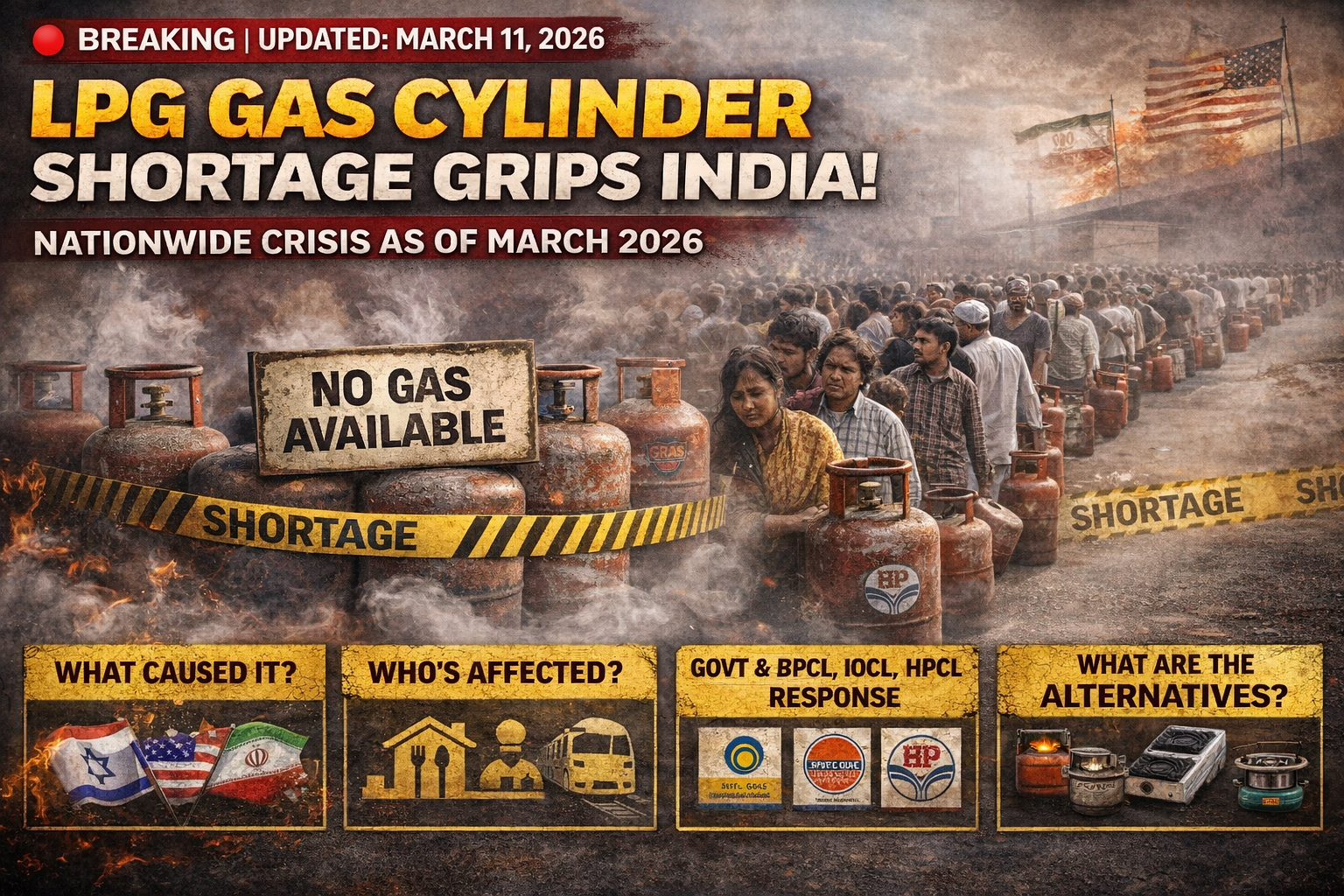
India is in the grip of a serious LPG gas cylinder shortage that is disrupting kitchens, restaurants, railway catering, and households across the country. From Mumbai to Kolkata, Bengaluru to Chennai, and even hill towns like Darjeeling, the gas shortage in India triggered by the escalating Iran-Israel-US war has become a national concern as of March 2026.
In this article, we break down everything you need to know — what caused it, who is affected, what BPCL, IOCL, and HPCL are doing, how IRCTC has responded, what the government’s priority order means for you, and what alternatives exist if your gas cylinder doesn’t arrive on time.
- What Caused the LPG Crisis in India?
- How Dependent Is India on Imported LPG?
- Government Response: Key Orders & Actions
- BPCL, IOCL & HPCL: What Oil Companies Are Doing
- IRCTC Directive: Railway Catering Switches to Induction
- City-Wise Impact: Mumbai, Bengaluru, Kolkata, Darjeeling & More
- Commercial Gas Cylinder Crisis: Restaurants on the Brink
- What About Your Home Gas Cylinder?
- Alternatives to LPG During the Shortage
- Frequently Asked Questions
🌍 What Caused the LPG Gas Cylinder Shortage in India?
The root cause of the LPG crisis in India is a sharp disruption in global energy supply chains resulting from the US-Israel war against Iran in early 2026. The ongoing conflict has severely strained shipping through the Strait of Hormuz — a narrow passage between Iran and Oman through which a massive share of the world’s oil and gas flows.
The military strikes from both sides have strained shipping through the Strait of Hormuz, a narrow passage between Iran and Oman that handles a significant share of global oil and gas trade. Several suppliers have also invoked force majeure clauses, legally excusing them from fulfilling their supply contracts due to the unforeseen conflict.
India depends heavily on imported LPG to meet domestic demand as the country consumes about 31.3 million tonnes of LPG annually and imports roughly 62 per cent of that requirement, much of it passing through the Strait of Hormuz, a crucial global energy shipping route.
This has triggered a domino effect — less imported gas arriving, oil companies unable to fill orders, distributors running dry, and restaurants, hotels, and households left scrambling for cylinders. Read: How much of India’s oil and LPG depends on the Strait of Hormuz? →
⛽ How Dependent Is India on Imported LPG?
The numbers reveal just how exposed India is to this kind of shock. According to Outlook Business, India’s LPG imports ranged from about 1.83 million tonnes to 2.03 million tonnes per month from February 2025 to February 2026, with the bulk sourced from Gulf suppliers:
- India consumes about 31.3 million tonnes of LPG annually, of which nearly 87 per cent is used in homes and the rest by commercial establishments such as hotels and restaurants. Around 62 per cent of the country’s LPG demand is met through imports.
- A large share of these imports — around 85–90 per cent — traditionally arrives through the Strait of Hormuz from countries such as Saudi Arabia.
- India is the world’s second-largest importer of LPG and consumed 31.3 million metric tons of LPG in the financial year 2025, according to a S&P Global report.
- The NRAI represents over 500,000 restaurants across India. India’s industry generates an annual turnover of over 5.7 trillion rupees ($78.9 billion) and employs over 8 million people.
Put simply, India’s LPG supply chain was heavily concentrated through a single maritime corridor — and the current conflict has effectively choked it. Read Business Standard’s full analysis on India’s LPG import vulnerability →
🏛️ Government Response: Key Orders & Actions (March 2026)
The Indian government has moved quickly, though the measures have directly caused the commercial gas cylinder shortage that restaurants and hotels are facing.
1. Natural Gas (Supply Regulation) Order, 2026
The government has issued the Natural Gas (Supply Regulation) Order, 2026 to control production, allocation and distribution of natural gas, including LNG and regasified LNG. The order said shipments have been disrupted through the Strait of Hormuz, prompting suppliers to invoke force majeure and divert gas to priority sectors.
The government has now identified four priority sectors for natural gas allocation to prevent a cooking gas shortage and maintain critical services. These are:
- Priority 1: Piped natural gas for households (100% of past 6-month average)
- Priority 2: CNG for public transport vehicles
- Priority 3: LPG production and essential pipeline operations
- Priority 4: Industrial and commercial consumers via City Gas Distribution (CGD) networks (80% supply)
2. Essential Commodities Act Invoked
To manage the situation, the government has invoked provisions under the Essential Commodities Act (ECA) and the Essential Services Maintenance Act (ESMA) to prioritise domestic LPG supplies for households over commercial users. Refineries have been asked to operate at full capacity while directing additional production primarily toward household consumption.
3. 25-Day Refill Booking Rule
To prevent misuse and panic booking, the refill booking cycle for LPG cylinders has been increased from 21 days to 25 days. This is a significant change — previously, a refill could be booked within 48 hours in many cities.
4. Price Hike
The prices of non-subsidised domestic LPG cylinders were increased by ₹60, the first one since April last year. The price of commercial LPG was also raised by ₹114.5 per 19 kg cylinder.
5. PM Modi’s Assurance
Prime Minister Narendra Modi on Tuesday told the Cabinet that war should not impact the common man. Earlier, Union Petroleum Minister Hardeep Singh Puri met him amid reports of LPG cylinder shortage in several cities.
6. Expanding Import Sources
Government officials said India is in a better position compared to several other countries and is in regular contact with multiple nations to ensure that energy supplies continue without disruption. According to Business Standard, India increased its import of gas from non-Strait of Hormuz routes to 70 per cent from 55 per cent earlier.
🛢️ BPCL, IOCL & HPCL: What India’s Oil Companies Are Doing
India’s three major oil marketing companies — BPCL (Bharat Petroleum), IOCL (Indian Oil), and HPCL (Hindustan Petroleum) — have jointly responded to the crisis.
In line with the Centre’s orders, state-run oil marketing companies — IOCL, BPCL, and HPCL — said they have taken steps to boost LPG production and prioritise its availability for domestic consumers and essential non-domestic sectors.
The Centre also ordered all refineries to use their propane, butane, propylene, and butene output entirely for LPG production. Domestic producers have been directed to supply all LPG output to IOCL, BPCL, and HPCL, which together supply more than 99 per cent of India’s domestic LPG.
Union Petroleum Minister Hardeep Singh Puri has established a three-member committee — comprising Executive Directors from IOC, HPCL, and BPCL — tasked with reviewing the grievances of restaurants, hotels, and catering associations.
All refineries are operating at full capacity, and around 60 lakh cylinders are supplied across the country every day.
✅ LPG production increased by 10%
✅ All refinery propane/butane output diverted to LPG
✅ 3-member committee formed for commercial supply grievances
✅ Imports diversified away from Strait of Hormuz (now 70%)
✅ Violations to be penalised under Essential Commodities Act
🚂 IRCTC Directive: Railway Catering Switches to Induction Cooking
One of the most significant institutional responses to the LPG shortage in India came from Indian Railways’ catering arm — IRCTC.
In a circular doing rounds on social media, released on March 10, 2026, IRCTC instructed all catering units in the West Zone to switch to alternative cooking methods, such as microwaves and induction cookers, in light of the ongoing shortage of LPG cylinders.
As per the guidelines, these stations must also maintain an adequate stock of Ready-to-Eat (RTE) food items to ensure passenger demand is met. IRCTC emphasised that these measures are critical to ensuring that travellers have uninterrupted access to food during their journey.
This move is intended to ensure that catering services remain unaffected as the crisis threatens to disrupt regular operations at Food Plazas, Refreshment Rooms (RR), and Jan Ahaars across Indian Railways.
This could lead to a shortage of cooked meals nationwide and potential refunds for pre-booked passengers. If you have pre-booked meals on a long-distance train, check IRCTC’s app or website for updates on your order status.
🗺️ City-Wise Impact: Where Is the Gas Shortage Worst?
📍 Mumbai
According to the Hotel Owners Association of Mumbai (AAHAR), approximately 8,000 hotels in the city are affected by the crisis. The organisation claims that approximately 20 per cent of hotels have already closed, and if the supply of commercial gas cylinders does not return to normal in the next two to three days, approximately 4,000 to 5,000 more hotels could close.
The ripple effects of the US-Israel strikes against Iran are now being felt in Mumbai, where citizens are now waiting two to eight days for refills of their domestic gas cylinders.
📍 Bengaluru
Distributors in Bengaluru said that although they currently have stock for the next four days, they have stopped supplies because oil companies did not refill commercial LPG cylinders. The price of a commercial cylinder in Bengaluru is currently ₹1,950 per cylinder. Reports have also emerged that some distributors are selling cylinders in the black market for up to ₹3,000.
📍 Kolkata & West Bengal (including Darjeeling region)
In Kolkata: Bakeries and restaurants are looking for alternatives after the Ministry suspended the distribution of Non-Domestic Non-Exempted Cylinders. The shortage has rippled across West Bengal, with the Darjeeling region’s tourism-heavy hospitality sector also at risk as hill restaurants and tea stalls depend almost entirely on commercial LPG cylinders.
📍 Chennai & Tamil Nadu
Nearly 10,000 establishments will shut down by Wednesday across India’s southernmost state, Tamil Nadu, M. Ravi, president of Chennai Hotel Association, told CNBC.
The Sree Annapoorna Sree Gowrishankar Group, a Coimbatore-based prominent eatery chain, put out a notice on Monday night informing customers that it will limit its menu to essential items, and the availability of some items will be restricted to specific hours of the day.
📍 Delhi-NCR
A gas agency owner in Delhi said that commercial gas is not arriving, and therefore, they are unable to supply it. A notice has also been posted outside the gas agency stating that supplies of commercial cylinders to hotels, restaurants and other establishments have been discontinued.
Black market prices in Delhi-NCR are reportedly as high as ₹1,500 for a domestic cylinder, as per local reports.
📍 Hyderabad & Other Cities
Hyderabad’s IT corridor hostels have reportedly begun facing breakfast disruptions, with some serving no dosa or puri bhaji due to the commercial gas cylinder shortage. Bhopal also witnessed a temporary halt in commercial LPG distribution, with only hospitals and educational institutions receiving supplies.
🍽️ Commercial Gas Cylinder Crisis: Restaurants on the Brink
The commercial gas cylinder crisis is at the heart of this emergency. Unlike domestic cylinders (14.2 kg), commercial cylinders are the larger 19 kg LPG cylinders used by restaurants, hotels, bakeries, catering services, and food businesses.
The Ministry of Petroleum and Natural Gas said that it was directing oil refineries to prioritise supplying LPG to the 330 million households that use it as a primary cooking fuel, over 3 million businesses that use commercial LPG cylinders. This is causing a “crisis situation” that will lead to the closure of many restaurants over the next few days, Sagar Daryani, president of the National Restaurant Association of India, told CNBC. He added that 90% of restaurants in India rely on LPG cylinders to run their kitchens.
Zorawar Kalra, restaurateur and vice-president of the NRAI, said the restaurant industry could face losses of around ₹1,200–1,300 crore per day if the disruption continues. He said that supplies of LPG cylinders are already tightening and nearly 70–75% of restaurants across India depend on LPG for their operations. [Source: BusinessToday — Full commercial LPG crisis explainer]
| City | Status | Hotels Affected |
|---|---|---|
| Mumbai | 🔴 Commercial supply halted | ~8,000 affected; 20% shut |
| Bengaluru | 🔴 Supply stopped; black market active | Industry on brink; CM wrote to Centre |
| Kolkata | 🔴 Non-domestic supply suspended | Bakeries & restaurants seeking alternatives |
| Chennai / TN | 🔴 Critical; 5 lakh cylinders halted | ~10,000 establishments at risk of closure |
| Delhi-NCR | 🟠 Commercial halted; domestic delayed | Agencies posting “no supply” notices |
| Hyderabad | 🟠 Shortage reported in IT corridor | Hostels affected; no breakfast items |
| Darjeeling / WB hills | 🟠 Supply tightening | Tourism sector & tea stalls at risk |
🏠 What About Your Home Gas Cylinder? (Domestic LPG Update)
The government has made it clear that domestic LPG cylinders are the top priority. However, households are still feeling the pinch:
- Domestic cylinders are facing delivery delays of two to eight days after booking.
- The refill booking window has been extended to 25 days (from 21), meaning you can only re-book after 25 days from your last booking.
- Government officials said there is no need to panic as authorities are actively working to meet the country’s oil and energy requirements.
- Hospitals and educational institutions continue to receive priority supply of imported LPG even under the crisis.
🔌 Alternatives to LPG During the Gas Shortage
With the LPG cylinder supply uncertain, many households and businesses are switching to electric alternatives. Here’s what’s working:
1. Induction Cooktops
Sales of induction cookers are increasing rapidly following news of an LPG shortage. According to the US Department of Energy, induction cookers heat up cookware much better than other methods — water can be brought to a boil up to 40% faster on induction cookers than on gas.
2. Microwave Ovens
IRCTC’s switch to microwave-based cooking at railway stations demonstrates that microwaves are a viable short-term alternative for heating and basic cooking, especially with Ready-to-Eat meals.
3. Electric Pressure Cookers & Rice Cookers
Apart from induction stoves, other appliances such as electric kettles, microwave ovens and electric rice cookers are also witnessing higher demand in several stores.
4. Piped Natural Gas (PNG) — Unaffected
If your home or business is connected to a piped natural gas network (such as GAIL’s infrastructure), you are currently unaffected. PNG household connections are Priority Sector 1 under the government’s order and continue to receive full supply.
- Book your LPG refill as soon as you cross 25 days from the last booking
- Avoid panic-buying or over-booking (it’s being monitored)
- Use pressure cookers to reduce gas consumption by up to 70%
- Consider buying an induction cooktop as a backup
- Avoid long-duration cooking; opt for quick one-pot meals
❓ Frequently Asked Questions About LPG Shortage in India
Why is there a gas cylinder shortage in India in 2026?
The gas cylinder shortage in India is caused by disruptions to global LPG supply chains following the US-Israel-Iran conflict in West Asia. The Strait of Hormuz — through which India imports 85–90% of its LPG — has been severely disrupted, leading to supply delays and the government prioritising domestic household supply over commercial users.
Is there an LPG shortage in my city?
As of March 11, 2026, the worst-affected cities for commercial gas cylinder supply are Mumbai, Bengaluru, Kolkata, Chennai, Delhi, and Hyderabad. Domestic household supply is being maintained, but delays of 2–8 days are common. Hill stations like Darjeeling in West Bengal are also reporting supply tightening.
What is the new LPG booking rule?
The government has extended the minimum gap between LPG refill bookings from 21 days to 25 days. You can only re-book your gas cylinder 25 days after your last booking to prevent hoarding and panic buying.
What is BPCL doing about the LPG shortage?
BPCL, along with IOCL and HPCL, has directed refineries to maximize LPG output, diverting all propane and butane production to LPG. A three-member committee of Executive Directors from these companies has been set up to review commercial supply grievances from hotel and restaurant associations.
What did IRCTC say about the LPG crisis?
IRCTC issued a directive on March 10, 2026, instructing catering units in its West Zone to switch from LPG cooking to electric induction stoves and microwave ovens. Railway food plazas, refreshment rooms, and Jan Aahar outlets are affected. IRCTC has also asked units to stock Ready-to-Eat items to ensure passengers continue to receive food service.
Will LPG prices increase further?
Domestic LPG prices have already been hiked by ₹60 per cylinder, while commercial cylinders went up by ₹114.5 per 19 kg cylinder in early March 2026. Further hikes will depend on how long the West Asia conflict continues and whether alternative supply routes can be scaled up.
What is the LPG shortage situation in Darjeeling?
Darjeeling, being part of West Bengal, is experiencing the indirect impact of the gas shortage in India. The region’s tourism-driven hospitality sector — restaurants, tea houses, and hotels — depends heavily on commercial LPG cylinders. With Kolkata distribution disrupted, supply to hill regions including Darjeeling has tightened considerably.
When will the LPG shortage end?
Industry officials say the shortage may not last long. Government authorities and oil companies are exploring alternative supply routes and working to secure additional shipments to stabilise availability. The government projects faster normalisation once the regional conflict stabilises and new LPG shipments via non-Hormuz routes begin arriving.
📌 What to Do Right Now
If you’re a household: Don’t panic. Book your refill when eligible (25-day rule), switch to induction as backup, and conserve gas by using pressure cookers and one-pot meals.
If you’re a restaurant or hotel owner: Register your grievance with the committee of EDs from BPCL, IOCL, and HPCL via your local OMC office. Consider temporary switches to induction cooking or electric cooking equipment. The government has stated that the genuine requirements of restaurants will be reviewed and addressed.
If you’re an IRCTC traveller: Carry backup snacks. Food plazas at some stations may have a limited menu. Track your e-catering orders via the IRCTC app.
Bookmark LifeHackHub for more such updates
Leave a Reply