📍 Launch site: Sunan area, near Pyongyang
🎯 Direction: Eastward — toward Sea of Japan (East Sea)
⏰ Detected: ~1:20 PM KST (0420 GMT)
🛬 Landing: Outside Japan’s Exclusive Economic Zone (EEZ)
🇯🇵 Japan status: Crisis team activated | PM Takaichi issues instructions
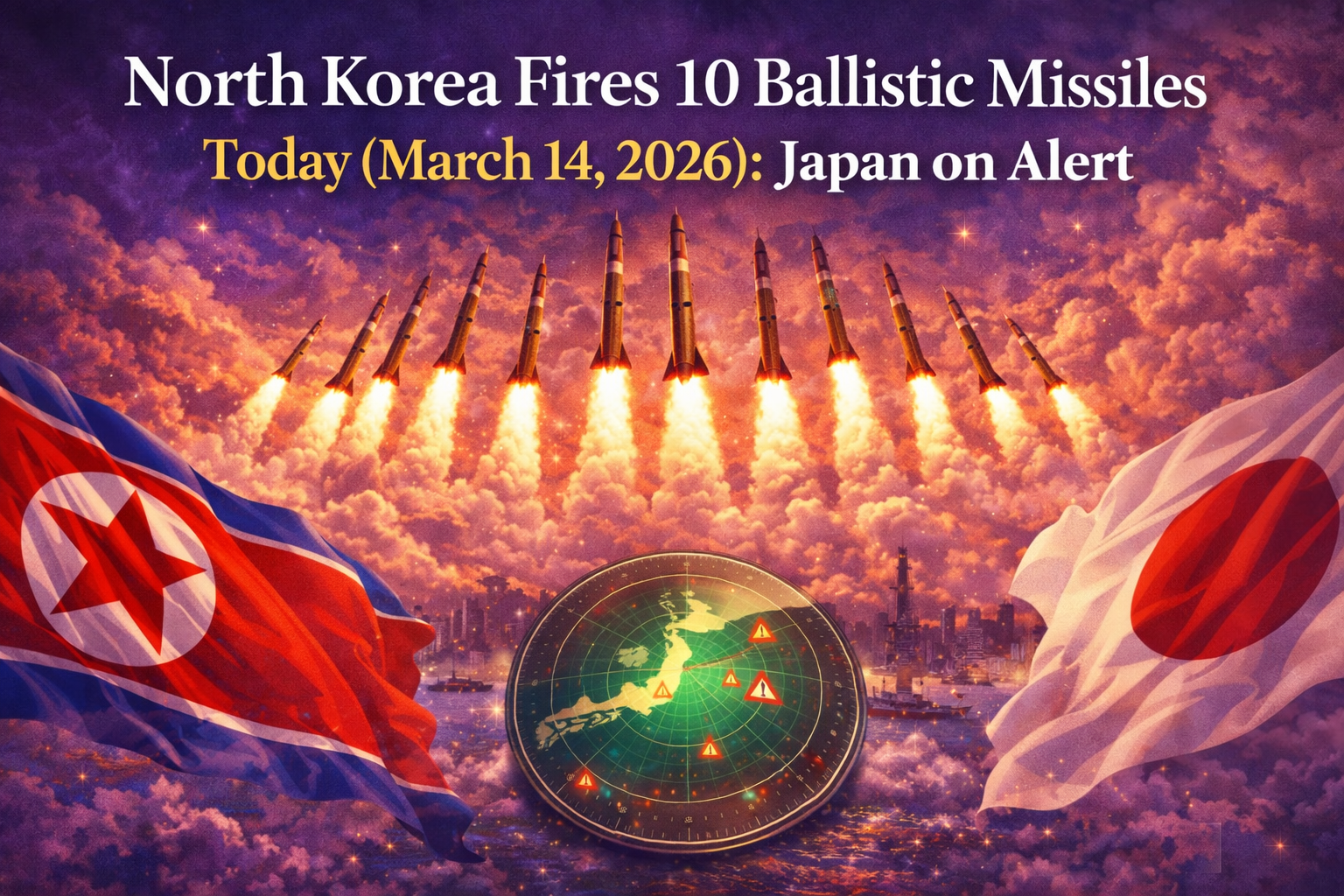
In one of the most aggressive weapons demonstrations of 2026, North Korea fired a salvo of approximately 10 ballistic missiles into the Sea of Japan on Saturday, March 14, 2026 — sending immediate alerts through Japan and South Korea, activating crisis response teams across the region, and drawing sharp global condemnation hours after the launches.
The launches — the third ballistic missile test by North Korea this year — came as the United States and South Korea were in the middle of their annual joint military exercise “Freedom Shield”, and just days after Kim Jong Un’s powerful sister Kim Yo Jong warned of “terrible consequences” for those who challenged Pyongyang’s security. It also comes amid the ongoing Iran-Israel-US war, which North Korea has publicly commented on — expressing solidarity with Tehran.
This post covers the complete picture: what was launched, from where, how far it flew, how Japan and South Korea responded, what Kim Jong Un’s strategic intent may be, and what happens next.
- What Happened: The March 14 Missile Launch
- Launch Details: 10 Missiles, Sunan, Sea of Japan
- Japan’s Response: PM Takaichi, Crisis Team & Condemnation
- South Korea’s Response: JCS Alert, Freedom Shield
- US Response & Trump-Kim Diplomacy Angle
- Kim Yo Jong’s Warning Days Before the Launch
- North Korea’s New Destroyer: The Choe Hyon Tests
- North Korea’s Support for Iran — The Global Context
- Japan’s Long-Range Missile Deployment Plan
- North Korea Missile Test Timeline: 2026
- Frequently Asked Questions
🚨 What Happened: North Korea’s March 14 Missile Launch
On Saturday, March 14, 2026, North Korea fired approximately 10 ballistic missiles toward the eastern sea in what analysts are calling a deliberate and large-scale show of force — timed to coincide with ongoing US-South Korea military drills and the escalating global security crisis triggered by the Middle East war.
According to Reuters, the missiles were fired from an area near Pyongyang at around 1:20 PM local Korean time (0420 GMT), travelling in an eastward direction toward the Sea of Japan — known in Korea as the East Sea. All missiles landed outside Japan’s Exclusive Economic Zone, causing no immediate casualties or damage.
As Zee News reports, the sheer scale of this salvo — 10 missiles fired in a coordinated burst — makes it one of Kim Jong Un’s most aggressive tactical demonstrations this year. North Korea has typically fired one to three missiles in shows of force, though exceptions like this have occurred before — notably in May 2024.
📡 Launch Details: 10 Missiles, Sunan Launch Site, Sea of Japan
Here is what is confirmed by South Korean and Japanese military sources as of the afternoon of March 14, 2026:
| Detail | Confirmed Information |
|---|---|
| Number of missiles | ~10 ballistic missiles (confirmed by South Korea JCS) |
| Launch site | Sunan area, near Pyongyang, North Korea |
| Launch time | ~1:20 PM KST (0420 GMT) on March 14, 2026 |
| Direction | Eastward, toward Sea of Japan (East Sea) |
| Range (approx.) | ~340 km — landed outside Japan’s EEZ |
| Type | Ballistic missiles (type under full analysis by US-ROK-Japan) |
| Landing zone | Outside Japan’s Exclusive Economic Zone (200 nautical miles) |
| Casualties / damage | None reported in Japan or South Korea |
| Context | During US-South Korea “Freedom Shield” drills (Mar 9–19) |
| This year’s count | 3rd ballistic missile test of 2026 (previous: Jan 4, Jan 27) |
The Japan Times reports that the Defence Ministry in Tokyo confirmed launches of “multiple ballistic missiles” from North Korea’s western coast, with the weapons travelling about 340 kilometres before landing outside Japan’s exclusive economic zone. This is the first ballistic missile launch by North Korea since January 27.
🇯🇵 Japan’s Response: PM Takaichi Activates Crisis Team
Japan reacted swiftly. According to Nikkei Asia, Japanese Prime Minister Sanae Takaichi immediately issued instructions to her government upon learning of the launches, directing officials to:
- Dedicate maximum effort to gathering and analysing information, and provide the public with timely updates
- Ensure the safety of aircraft, vessels, and other Japanese assets in the affected region
- Take all possible precautionary measures, including full readiness for contingencies
Japan’s Coast Guard issued alerts to all vessels at sea in the region, urging them to pay close attention to further official information. Seoul Economic Daily reports that the Japanese Defence Ministry confirmed the launch as an object “possibly a ballistic missile” that “appears to have already fallen,” and confirmed landing coordinates well outside Japan’s EEZ.
Japan has filed a strong diplomatic protest with North Korea through its embassy in Beijing — the channel used given the absence of direct diplomatic relations between the two countries. Defence Minister Shinjiro Koizumi said Japan was coordinating closely with the United States and South Korea and stressed that “North Korea’s nuclear and missile development threatens the peace and stability of Japan and the international community, and is totally unacceptable.”
🇰🇷 South Korea’s Response: JCS on High Alert & Freedom Shield Drills
South Korea’s Joint Chiefs of Staff (JCS) was the first to detect and confirm the launch. In an official statement, they said the missiles were detected at approximately 1:20 PM KST, from the Sunan area near Pyongyang, and announced that the South Korean military has immediately stepped up surveillance and is maintaining readiness against possible additional launches while closely sharing intelligence with the United States and Japan.
WION reports that the JCS statement noted: “Our military is fully prepared and is sharing information related to North Korean ballistic missiles with the United States and Japan. At the same time, additional missiles are being closely monitored.”
The timing is significant: South Korea and the United States kicked off their annual springtime “Freedom Shield” exercise on Monday, March 9, involving approximately 18,000 Korean and US troops, running until March 19, 2026. As noted by NBC News, North Korea has staged its own show of force directly in response to these exercises — a well-established pattern that has repeated almost every year for the past decade.
🇺🇸 US Response & The Trump-Kim Diplomacy Angle
The missile launches come at a particularly complex diplomatic moment. Al Arabiya reports that on the same day as the launches — Saturday, March 14 — South Korean Prime Minister Kim Min-seok met US President Donald Trump in Washington to discuss reopening dialogue with North Korea. Trump reportedly told Kim that meeting Kim Jong Un would be “good”, and a potential meeting could happen during Trump’s upcoming visit to Beijing later in March.
Trump had previously said during a trip to Asia in October that he was “100 percent” open to meeting Kim Jong Un — an overture that Pyongyang had largely ignored for months. But recently, Kim Jong Un himself said the two nations could “get along” if Washington accepted Pyongyang’s nuclear status — a significant shift in tone. North Korea has repeatedly rejected US and South Korean calls to resume denuclearisation diplomacy since talks collapsed in 2019 at the Hanoi summit.
The 10-missile salvo fired just hours after that Washington meeting may be Pyongyang’s way of asserting its position simultaneously: opening a door to diplomacy on one hand, while demonstrating nuclear deterrence capability with the other.
⚠️ Kim Yo Jong’s “Terrible Consequences” Warning — Days Before the Launch
The launches did not come without warning. Just days before the March 14 salvo, Kim Yo Jong — the powerful sister of Kim Jong Un and a central figure in North Korean policy — released a sharp statement criticising Washington and Seoul for proceeding with the Freedom Shield military exercises. She warned that any challenge to North Korea’s safety would bring “terrible consequences.”
As NBC News reports, Kim Yo Jong stopped short of directly mentioning the Iran war, but said the US-South Korea drills “undermine regional stability at a time when the global security structure is collapsing rapidly and wars break out in different parts of the world due to the reckless acts of outrageous international rogues.” This was widely interpreted as a reference to the ongoing US-Israel-Iran military conflict in the Middle East.
North Korea’s Foreign Ministry also released separate statements denouncing the joint US-Israeli attacks on Iran and expressing support for Tehran’s new supreme leader, Mojtaba Khamenei — signalling a deepening ideological alignment between Pyongyang and Tehran that has geopolitical implications far beyond the Korean peninsula.
🛳️ North Korea’s New Destroyer: The Choe Hyon Cruise Missile Tests
Saturday’s ballistic missile barrage follows a series of provocations earlier in the week tied to a major new military asset. On Tuesday, March 10, Kim Jong Un observed a second test of cruise missiles launched from North Korea’s newest warship — the Choe Hyon destroyer. A similar strategic cruise missile test was conducted from the same destroyer the week before, ahead of its formal commissioning.
Stars and Stripes reports that state media photos showed Kim Jong Un and his daughter Kim Ju Ae observing the tests via video. The Choe Hyon destroyer represents a significant advancement in North Korea’s naval capabilities — the ability to launch cruise missiles from a naval platform adds a new dimension to Pyongyang’s strike options that previously had been largely land-based.
North Korea also condemned Japan’s plan to deploy upgraded long-range missiles across the country, calling the move “an extremely dangerous military act.” Pyongyang’s state-run Korean Central News Agency (KCNA) said the deployments would allow Japan to target neighbouring countries from multiple locations — a reference to the fact that Japan’s new long-range missiles could reach Chinese and North Korean territory.
🌍 North Korea, Iran & the Global Security Picture
What makes this missile launch particularly alarming to global security analysts is the context in which it occurs. The world is simultaneously witnessing:
- An active US-Israel-Iran war in the Middle East, now in its 15th day, with massive disruptions to Strait of Hormuz shipping
- North Korea publicly supporting Iran and condemning US military actions
- North Korea accelerating its weapons testing programme — ballistic missiles, cruise missiles from naval platforms, and hypersonic missile tests in January
- Zee News analysis noting that experts believe Kim Jong Un is accelerating his “Tactical Nuclear” doctrine — designed to prove North Korea can overwhelm regional defences with sheer numbers, similar to the “saturation strikes” Iran deployed at the start of the current Middle East conflict
- Ongoing Russia-Ukraine tensions to the west
As Zee News puts it: “As the smoke clears over the East Sea, the world is faced with the grim reality that the threat of a multi-front global war has graduated from the realm of theoretical threat to the realm of actual military challenge.”
🗾 Japan’s Long-Range Missile Deployment — Why North Korea Is Watching Closely
One of the key triggers for Pyongyang’s heightened aggression toward Japan specifically is Tokyo’s decision to deploy its own upgraded long-range missiles across Japan’s territory — a landmark shift in Japanese defence posture. Historically, Japan’s pacifist constitution has constrained its military ambitions, but recent years have seen a fundamental rethinking of that posture in the face of North Korean and Chinese military expansion.
Stars and Stripes reports that North Korea condemned these plans on Friday (March 13), calling Japan’s missile deployment plans “undoubtedly an extremely dangerous military act.” KCNA stated that “if this becomes reality, Japan would be deploying missiles capable of targeting neighbouring countries across the entire nation” — a clear reference to the fact that Japan’s new missiles can reach North Korean and Chinese territory.
This mutual escalation — North Korea expanding its missile programme, Japan developing counter-strike capabilities, and the US reinforcing its military alliance posture in the region — creates a dangerous feedback loop that security analysts warn is pushing Northeast Asia closer to a genuine military crisis.
📅 North Korea Missile Test Timeline: 2026
| Date | Event | Details |
|---|---|---|
| Jan 4, 2026 | Hypersonic missile test | 2 hypersonic missiles from Ryokpho, Pyongyang; 1,000 km range; Kim Jong Un presided |
| Jan 27, 2026 | Short-range ballistic missiles | Several SRBMs fired toward East Sea; Japan and South Korea confirmed |
| Mar 4–5, 2026 | Cruise missile test (Choe Hyon destroyer) | First test of cruise missiles from North Korea’s new naval destroyer, the Choe Hyon |
| Mar 10, 2026 | Cruise missile test #2 (Choe Hyon) | Second cruise missile test from destroyer; Kim Jong Un & Kim Ju Ae observed |
| Mar 13, 2026 | Kim Yo Jong’s warning | Threatens “terrible consequences” over Freedom Shield; North Korea condemns Japan missile plans |
| Mar 14, 2026 🔴 | ~10 ballistic missiles | Largest salvo of 2026 — Sunan, Pyongyang — Sea of Japan — 340 km range — TODAY |
For a comprehensive history of all North Korean missile tests, see the NK News missile tracker →
❓ Frequently Asked Questions — North Korea Missile Launch March 14, 2026
Did North Korea launch missiles today?
Yes. On Saturday, March 14, 2026, North Korea launched approximately 10 ballistic missiles toward the Sea of Japan (East Sea) from the Sunan area near Pyongyang. The missiles were detected at around 1:20 PM Korean time and landed outside Japan’s Exclusive Economic Zone. Both South Korea’s Joint Chiefs of Staff and Japan’s Defence Ministry confirmed the launches.
Why did North Korea launch missiles today?
The launch appears to be a deliberate show of force in response to the annual US-South Korea “Freedom Shield” military exercises, which began on March 9 and run until March 19. North Korea has consistently used missile tests to signal opposition to these drills, which it considers rehearsals for invasion. The timing also coincides with the ongoing Iran-Israel-US war in the Middle East, which North Korea has publicly commented on — expressing solidarity with Iran.
How many missiles did North Korea fire on March 14, 2026?
South Korea’s Joint Chiefs of Staff and Japan’s Defence Ministry confirmed that approximately 10 ballistic missiles were launched. This is one of the largest single-day salvos North Korea has fired, reflecting what analysts describe as Kim Jong Un’s “saturation strike” tactical nuclear doctrine.
Did the North Korea missiles reach Japan?
No. According to Nikkei Asia and Japan’s Defence Ministry, all missiles landed outside Japan’s Exclusive Economic Zone — which extends 200 nautical miles from Japan’s coast. Japan’s Coast Guard urged vessels in the region to monitor the situation. No damage or casualties were reported in Japan.
How did Japan respond to the North Korea missile launch?
Japanese Prime Minister Sanae Takaichi immediately activated a government crisis team and issued official instructions to gather information, protect aircraft and vessels, and maintain full contingency readiness. Japan lodged a strong diplomatic protest with North Korea through its embassy in Beijing, and Defence Minister Koizumi said the launches are “totally unacceptable.”
What is Freedom Shield?
Freedom Shield is the annual joint military exercise conducted by the United States and South Korea. The 2026 edition began on March 9 and runs through March 19, involving approximately 18,000 South Korean and US troops. North Korea routinely responds to Freedom Shield with missile tests, condemning the exercises as preparations for war.
What is North Korea’s Choe Hyon destroyer?
The Choe Hyon is North Korea’s newest naval destroyer, recently commissioned into the Korean People’s Navy. Kim Jong Un has overseen two cruise missile tests from this warship in March 2026 alone (March 4–5 and March 10), demonstrating North Korea’s growing naval strike capability — adding a sea-based dimension to its already advanced land-based missile programme.
Is North Korea supporting Iran?
Yes. North Korea’s Foreign Ministry has released statements denouncing the US-Israeli military strikes on Iran and expressing support for Tehran’s new supreme leader, Mojtaba Khamenei. Analysts view this as part of an emerging alignment of anti-Western states — Russia, North Korea, and Iran — that share military intelligence, technology, and political support.
How many times has North Korea tested missiles in 2026?
As of March 14, 2026, North Korea has conducted three ballistic missile tests this year: January 4 (hypersonic missiles), January 27 (short-range ballistic missiles), and today, March 14 (~10 ballistic missiles). It has also conducted two cruise missile tests from the Choe Hyon destroyer in early March.
📌 What to Watch Next
With Freedom Shield exercises running until March 19, analysts warn that further North Korean provocations are possible before the drills conclude. Kim Jong Un has used every past edition of Freedom Shield to demonstrate weapons capability — and the 2026 edition, coming amid a global security crisis, gives Pyongyang even more motivation to project strength.
The diplomatic track is also worth watching. Trump’s planned visit to Beijing later in March — and his expressed openness to meeting Kim Jong Un — could shift the dynamic quickly, for better or worse.
What is clear is that Northeast Asia has entered one of its most volatile periods in years — and North Korea’s 10-missile barrage today is both a symptom and an accelerant of that volatility.
🚀 Missiles fired: ~10 ballistic missiles
📍 Launch site: Sunan, near Pyongyang
🎯 Target direction: Sea of Japan (East Sea)
📏 Range: ~340 km — outside Japan EEZ
🇯🇵 Japan response: Crisis team | PM Takaichi instructed | Diplomatic protest
🇰🇷 South Korea: JCS on high alert | Freedom Shield ongoing
🇺🇸 US angle: Trump seeks Kim dialogue | Freedom Shield in progress
🔢 2026 test count: 3rd ballistic missile test (+ 2 cruise missile tests)