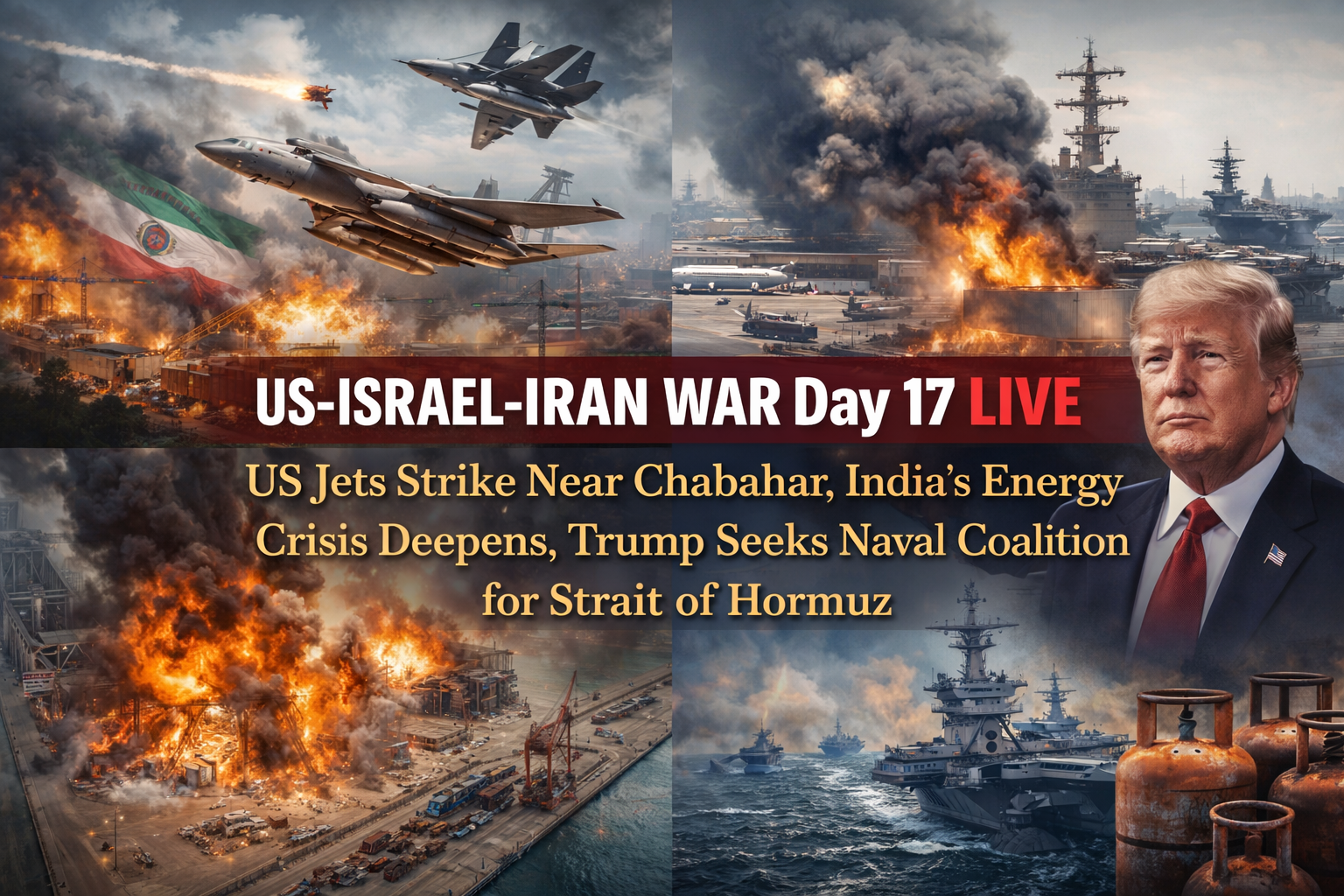
🔥 Iran retaliates: Qatar’s Ras Laffan LNG hub hit TWICE — “extensive damage” confirmed
💣 Iran hits Saudi Arabia’s Samref Refinery + Jubail Petrochemical Complex — 2 refineries attacked in Riyadh
⚠️ Iran strikes UAE’s Al Hosn Gas Field + Habshan facility — Abu Dhabi gas operations suspended
🛢️ Oil surges to $110/barrel (up from $71 on Feb 27 — +55% in 20 days)
☢️ Trump threatens to “massively blow up the entirety of South Pars” if Iran attacks Qatar again
☠️ Iran kills Intelligence Minister Esmail Khatib — Israel confirms strike | Security chief Ali Larijani killed day before
🚢 Two vessels struck in Persian Gulf — Maltese container ship “Safeen Prestige” on fire in Hormuz
🤝 Qatar expels Iranian military & security attachés — 24-hour ultimatum issued
🇸🇦 Saudi FM: “The little trust that remained with Iran has been completely shattered” — reserves right to military action
🇫🇷 Macron calls for moratorium on strikes targeting civilian energy infrastructure
The US-Israel-Iran war entered its most catastrophic phase yet on Wednesday and Thursday, March 18–19, 2026, as the conflict broke a terrifying new frontier: the deliberate targeting of the world’s most critical energy infrastructure. In a single 24-hour period, the world’s largest natural gas field was bombed, the globe’s biggest LNG export terminal was struck twice, two Saudi refineries were hit, and UAE gas operations were suspended — triggering a price shock that sent oil surging to $110 per barrel and sent shockwaves through every economy on earth.
The escalation spiral began when Israel struck Iran’s South Pars gas field — a move that CNN described as “a serious escalation” because South Pars is the world’s largest natural gas deposit, shared by Iran and Qatar — a close US ally. Iran retaliated with furious speed, launching ballistic missiles at Qatar’s Ras Laffan Industrial City — the world’s largest LNG export facility — causing “extensive damage.” It then turned its missiles on Saudi Arabia and the UAE. Saudi Arabia declared the tiny trust it had left in Iran was “completely shattered” and reserved the right to military action. Qatar expelled Iranian diplomats. And US President Donald Trump posted a threat that shook global markets: if Iran attacks Qatar again, the US will “massively blow up the entirety of the South Pars Gas Field.”
- What Is South Pars? Why Striking It Changes Everything
- Israel’s South Pars Strike — What Happened & Who Approved It
- Iran Retaliates: Qatar’s Ras Laffan Hit Twice — World’s Biggest LNG Hub in Flames
- Saudi Arabia & UAE Energy Sites Under Attack
- Trump’s Explosive Threat: “Massively Blow Up South Pars”
- Qatar Expels Iranian Diplomats | Saudi FM’s Warning | Arab Foreign Ministers Meet
- Global Energy Markets in Freefall — Oil at $110
- Iran’s Intelligence Minister Killed | Security Chief Ali Larijani Eliminated
- Global Reactions: Macron, EU, NATO, Germany
- Vessels Struck in Hormuz — Safeen Prestige Container Ship on Fire
- Full War Scoreboard: Day 20
- Frequently Asked Questions
🔥 What Is South Pars? Why Striking It Changes Everything
To understand why the world reacted with such alarm to this strike, you need to understand what South Pars is.
South Pars is the Iranian sector of the world’s largest natural gas deposit — a massive offshore field located in the Persian Gulf, straddling the maritime border between Iran and Qatar. As Middle East Eye explains, Qatar fully shut its LNG production due to the war — cutting 20 per cent of the world’s liquid natural gas supplies — and had warned that any damage to these shared facilities could have catastrophic global consequences.
| South Pars — Key Facts | Data |
|---|---|
| Status | World’s largest natural gas field |
| Location | Persian Gulf — shared between Iran & Qatar |
| Iran’s sector name | South Pars (Iranian side) |
| Qatar’s sector name | North Dome (Qatari side) — feeds Ras Laffan LNG hub |
| Global significance | Qatar’s North Dome alone supplies ~20% of world’s LNG |
| Why Qatar is alarmed | Field is geologically shared — damage on one side affects the other |
| Previous status | First time since Feb 28 that Israel targeted Iranian natural gas production infrastructure |
| Oil market reaction | Brent crude jumped above $108–$110/barrel on news of the strike |
This was a watershed moment. From the start of the war on February 28, both sides had — until now — largely spared energy production infrastructure, calculating that destroying the world’s energy arteries would create consequences too catastrophic to manage. That threshold has now been crossed. Bloomberg’s analysis confirms that consuming nations had hoped the Strait of Hormuz disruption would prove short-lived “as long as production infrastructure was spared” — and that calculation has now been shattered.
💥 Israel’s South Pars Strike — What Happened & Who Approved It
CBC News confirms that Iran accused Israel of striking its facilities in the huge South Pars field on Wednesday in what it called a major escalation. The attack caused fires at gas tanks and parts of a refinery. Workers were evacuated. Iranian state media later said the fire was “under control,” but the psychological and geopolitical damage was far beyond the physical.
The question of US involvement immediately became a political flashpoint. CNBC reports that Trump pushed back against reports the strikes were “coordinated with and approved by his administration.” In a Truth Social post, Trump wrote: “The United States knew nothing about this particular attack, and the country of Qatar was in no way, shape, or form, involved with it, nor did it have any idea that it was going to happen.”
However, Middle East Eye’s reporting cites an Israeli official — speaking anonymously — saying the attack on South Pars was done “with US approval and coordination.” This direct contradiction between Trump’s public denial and the Israeli official’s claim has deepened the credibility crisis around the administration’s management of the war.
Earlier that same Wednesday, Trump had posted on Truth Social: “Remember, for all of those absolute ‘fools’ out there, Iran is considered, by everyone, to be the NUMBER ONE STATE SPONSOR OF TERROR. We are rapidly putting them out of business!”
🇶🇦 Iran Retaliates: Qatar’s Ras Laffan Hit TWICE — World’s Biggest LNG Hub in Flames
Iran’s response to the South Pars strike was swift, targeted, and devastating. CNN’s live blog confirms that Iran hit Qatar’s Ras Laffan Industrial City twice within 12 hours, causing “extensive damage” with fires reported at the facility on both occasions.
Ras Laffan Industrial City is not just Qatar’s most important facility — it is the world’s largest LNG export complex, the engine of Qatar’s extraordinary wealth, and a critical pillar of global energy supply. CNBC notes that state-owned QatarEnergy confirmed “extensive damage” from the strikes, warranting deployment of emergency response teams to contain fires at the site. QatarEnergy stated several of its LNG facilities were struck in the early hours of Thursday as well, “causing significant fires and extensive damage.”
- Home to the world’s largest LNG export plant
- Qatar supplies approximately 20% of global LNG — primarily to Europe, Japan, South Korea, India
- Qatar had already shut LNG production since the war began due to Hormuz closure
- Physical damage to Ras Laffan infrastructure could take months to years to repair
- Europe — which switched to Qatari LNG after Russia’s gas cuts — faces a compounding energy crisis
Qatar’s foreign ministry spokesperson Majed Al-Ansari condemned Israel’s attack on the shared South Pars field as “a dangerous and irresponsible step amid the current military escalation in the region,” while separately denouncing Iran’s attack on Ras Laffan as “a flagrant breach of international law.” Qatar thus found itself simultaneously condemning both sides — the unique anguish of a small nation caught between warring giants over a gas field it shares with one and hosts bases for another. The Peninsula Qatar’s live blog confirmed Qatar ordered Iranian Embassy military and security attachés declared “persona non grata,” demanding they leave within 24 hours.
🇸🇦🇦🇪 Saudi Arabia & UAE Energy Sites Under Attack — Riyadh Warns of Military Response
Qatar was not Iran’s only target. In a pre-announced list of “direct and legitimate targets” broadcast by Iran’s semi-official Tasnim news agency, Middle East Eye reports that Iran ordered the evacuation of the following facilities “in the coming hours”:
- 🇸🇦 Saudi Arabia: Samref Refinery (Yanbu) + Jubail Petrochemical Complex
- 🇦🇪 UAE: Al Hosn Gas Field + Habshan facility
- 🇶🇦 Qatar: Mesaieed Petrochemical Complex + Mesaieed Holding Company + Ras Laffan Refinery
🇸🇦 Saudi Arabia
CNN confirms two of Saudi Arabia’s refineries in Riyadh were attacked on Wednesday. Saudi Arabia’s air defences intercepted and destroyed more than a dozen drones in the eastern parts of the country, including one drone that had been heading directly for a gas facility. Four people were injured when shrapnel from intercepted missiles fell on a residential area in Riyadh.
Saudi Foreign Minister Prince Faisal bin Farhan Al-Saud delivered the region’s starkest warning yet: as CNBC reports, bin Farhan said Saudi Arabia was “not going to succumb to pressure” and that the pressure would “backfire.” He stated that “the little trust that remained with Iran has been completely shattered” and that both political and non-political responses — including military action — remain on the table. “We have reserved the right to take military actions, if deemed necessary, and if the time comes, the leadership of the Kingdom will take the necessary decision.” US News & World Report confirms Saudi Arabia also chaired a consultative meeting of foreign ministers from 12 Arab and Islamic nations in Riyadh on Thursday.
🇦🇪 UAE
CNN’s live update confirms gas operations at crucial energy sites in Abu Dhabi were temporarily suspended after debris from intercepted missiles fell on the facilities. Iran separately set a massive gas field in the UAE ablaze — the first time the Islamic Republic had damaged an oil or gas upstream facility in a neighbouring country during this war. The UAE Ministry of Foreign Affairs called Iran’s targeting of its Habshan gas facility and Bab field a “terrorist attack” risking a “dangerous escalation.”
Senior UAE adviser Anwar Gargash said Iran had miscalculated badly: the attacks would drive Gulf states “closer to Israel and the US, while demonstrating why the region can’t accept Iranian nuclear and missile programs.” Bloomberg reports Gargash signalled the UAE may be willing to help secure the Hormuz strait — a significant diplomatic shift from the UAE’s previous neutrality.
⚡ Trump’s Explosive Threat: “Massively Blow Up” South Pars
The most dramatic diplomatic moment of Day 19–20 came from US President Donald Trump, who issued a warning on social media that sent shockwaves through every energy market on earth.
“If Iran attacks Qatar again, the United States will massively blow up the entirety of the South Pars Gas Field at an amount of strength and power that Iran has never seen or witnessed before.”
— US President Donald Trump, Truth Social, March 18–19, 2026
CNBC’s full report on Trump’s statement notes he simultaneously urged Israel to end attacks on South Pars — “unless Iran ‘unwisely’ decides to attack Qatar again.” This double message — threatening to destroy the field while telling Israel to stop hitting it — captures the profound internal contradiction in US policy on Day 20.
The threat carries extraordinary consequences. South Pars is shared between Iran and Qatar. Destroying it entirely would not just devastate Iran — it would eliminate Qatar’s entire gas production base, collapse Qatar’s economy, and remove approximately 20% of the world’s LNG supply overnight. The threat, if carried out, would produce the greatest peacetime energy catastrophe in modern history. US News & World Report confirms the threat caused global oil prices to surge on international markets, increasing the cost of gasoline and other goods while squeezing the global economy.
The US Senate, meanwhile, voted on a war powers resolution that would have required congressional approval for continuing the war — it failed along party lines, with Democrats forcing the vote largely to create a debate record.
🤝 Qatar Expels Iranian Diplomats | Saudi FM’s Warning | 12 Arab Nations Meet
The energy attacks triggered an unprecedented diplomatic rupture across the Gulf:
🇶🇦 Qatar’s Diplomatic Expulsion
As The Peninsula Qatar confirms, Qatar ordered Iranian Embassy military and security attachés and their staff declared “persona non grata” — demanding they leave the country within a maximum of 24 hours. This is a near-complete diplomatic rupture short of full ambassador recall. Qatar simultaneously condemned Israel’s attack on South Pars as “dangerous and irresponsible” — the small nation is navigating an impossible position as home to the world’s largest US military base (Al Udeid) while also sharing a gas field with Iran.
🇸🇦 12-Nation Arab & Islamic Foreign Ministers Meeting
CNN confirms that the foreign ministers of 12 Arab and Islamic states issued a joint statement Thursday after their emergency meeting in Riyadh. The statement called on Iran to “immediately halt its attacks” and respect international law, while denouncing Iranian attacks on Gulf states, Jordan, Azerbaijan, and Turkey. Specifically, they condemned strikes on “residential areas, civilian infrastructure, including oil facilities, desalination plants, airports, residential buildings and diplomatic premises.” The ministers also condemned Israel’s attacks on Lebanon and reaffirmed support for Lebanon’s sovereignty.
🇫🇷 Macron’s Emergency Calls
CBC News reports French President Emmanuel Macron spoke by phone with both the Emir of Qatar and President Trump and issued a public call: “It is in our common interest to implement, without delay, a moratorium on strikes targeting civilian infrastructure, particularly energy and water supply facilities. Civilian populations and their essential needs, as well as the security of energy supplies, must be protected from military escalation.”
📈 Global Energy Markets in Freefall — Oil at $110/Barrel
The energy attacks have produced a market shock of historic proportions. Bloomberg confirms Brent crude rallied above $108 per barrel immediately after Iran’s warning and the South Pars attack. CNN’s live blog records that oil prices surged to $110 per barrel as the strikes on energy infrastructure across the Middle East hit markets simultaneously.
| Energy Crisis Timeline | Price / Impact | Source |
|---|---|---|
| Feb 27 (Day before war) | $71/barrel | Bloomberg |
| Mar 9 (Day 9) | $104/barrel — Strait effectively closed | CNN |
| Mar 18 (South Pars strike) | $108–$110/barrel — surges 4%+ in single session | CNBC |
| Total increase in 20 days | +55% — oil has soared almost 50% since war began | Bloomberg |
| US gasoline average price | $3.79/gallon — rising sharply | Bloomberg / AAA |
| Qatar LNG to global market | ~20% of world LNG supply — already shut since war began | Middle East Eye |
| Strait of Hormuz crude traffic | ~zero — effectively closed since Mar 4 | CBC News |
| EU position | EU FM Kallas: safe passage through Hormuz a “priority for Europe”; supports diplomatic solution | CBC News |
Bloomberg’s market analysis notes that consuming nations had hoped the disruption would prove short-lived as long as production infrastructure was spared. The events of March 18–19 have shattered that hope entirely. German Foreign Minister Johann Wadephul warned of “a crisis of the gravest order” if global supply chains continued to be disrupted, calling for de-escalation and a cessation of hostilities.
☠️ Iran Kills Intelligence Minister Esmail Khatib | Security Chief Ali Larijani Eliminated
Simultaneous with the energy infrastructure strikes, Israel continued its systematic decapitation of Iran’s security and intelligence leadership — producing what analysts are calling an unprecedented leadership vacuum in Tehran.
CBC News confirms that Israel killed Iran’s Intelligence Minister Esmail Khatib on Wednesday — just one day after the killing of powerful security chief Ali Larijani. The back-to-back elimination of two of Iran’s most senior security officials in 48 hours represents an extraordinary intelligence and military operation.
The leadership casualties since the war began on February 28 include Supreme Leader Ali Khamenei (killed in opening strikes), multiple IRGC commanders, and now the Intelligence Minister and Security Chief. Insurance Journal’s Bloomberg-syndicated analysis notes the death toll from US-Israeli attacks has now surpassed 3,000, with more than 1,351 civilians killed including at least 207 children, according to the US-based rights group HRANA.
🌍 Global Reactions: Macron, NATO, Germany — World Scrambles to Contain Crisis
CNBC’s comprehensive global reactions report captures the intensity of international alarm:
- 🇫🇷 France (Macron): Called Qatari Emir and Trump. Demanded moratorium on civilian infrastructure strikes. “Civilian populations and their essential needs must be protected.”
- 🇩🇪 Germany (Wadephul): Warned of “a crisis of the gravest order.” Called for de-escalation once US-Israeli objectives achieved. Previously stated the Iran war is “not NATO’s war.”
- 🇪🇺 EU (Kallas): Spoke with Iranian FM Araghchi. Said Hormuz safe passage is a “priority for Europe.” Supports diplomatic solution. Discussing expanding mandate of EU’s Aspides Naval Mission.
- 🏛️ NATO (Rutte): Confirmed members discussing “the best way” to open the Strait. “I have been in contact with many allies.”
- 🇸🇪 Sweden: FM Malmer Stenergard confirmed Iran executed a Swedish citizen on Wednesday — condemned the death penalty as “inhumane, cruel and irreversible.”
- 🇮🇳 India: EAM Jaishankar continuing negotiations for safe passage for Indian vessels. 22 Indian-flagged ships remain stranded. The Ras Laffan strike directly threatens India’s LNG supply — Qatar is India’s single largest LNG supplier.
🚢 Vessels Struck in Hormuz — Safeen Prestige Container Ship on Fire
CNN’s live blog confirms that a vessel was struck by an “unknown projectile” causing a fire off the UAE’s east coast near the Strait of Hormuz. A new satellite image taken on March 18 shows large plumes of smoke billowing from the Maltese-flagged Safeen Prestige container ship as it drifts in the Strait of Hormuz. A second vessel was separately struck in the Persian Gulf in the early hours of Thursday. The UK Maritime Trade Operations (UKMTO) agency confirmed both incidents.
Over 20 vessels have been attacked during the Iran war so far as Tehran continues to squeeze global shipping as part of its pressure campaign. US News notes the Trump administration separately waived the Jones Act — a 1920s law requiring goods shipped between US ports to be carried on US-flagged vessels — as global oil prices spike.
📊 Iran War Full Scoreboard — Day 20 (March 19, 2026)
| Category | Data | Source |
|---|---|---|
| War started | February 28, 2026 — US-Israeli joint strikes open war | CBC |
| Civilian deaths in Iran | 1,351+ civilians including 207+ children (HRANA) | Middle East Eye |
| Total war deaths | 3,000+ (3/4 in Iran, + Lebanon, Gulf, US) | Middle East Eye |
| Lebanon deaths (Israeli strikes) | 900+ killed by Israeli strikes on Lebanon (Lebanese govt) | Bloomberg |
| US military deaths | 13 military personnel | Bloomberg |
| Iran senior officials killed | Supreme Leader Khamenei + Ali Larijani (security chief) + Esmail Khatib (intel minister) | CBC |
| Iran missiles fired total | 700+ at US/Israeli targets | CNN |
| Iran drones fired total | 3,600+ at US/Israeli targets | CNN |
| Key new: South Pars struck | Israel bombs world’s largest gas field — first energy production strike | CNBC |
| Key new: Ras Laffan hit | Twice — world’s largest LNG export facility “extensively damaged” | CNN |
| Global oil price (Day 20) | $110/barrel (up 55% since Feb 27) | CNN |
| Vessels attacked since war | 20+ — Safeen Prestige on fire in Hormuz (March 18) | US News |
❓ Frequently Asked Questions — Iran War Day 19–20
What happened on Day 19–20 of the Iran war?
In the most dangerous 24-hour escalation since the war began: Israel bombed South Pars (world’s largest gas field), Iran retaliated by striking Qatar’s Ras Laffan LNG hub twice causing “extensive damage,” hit two Saudi refineries in Riyadh, and attacked UAE gas facilities in Abu Dhabi. Oil surged to $110/barrel. Trump threatened to “massively blow up” South Pars. Qatar expelled Iranian military diplomats. Saudi Arabia reserved the right to military action. CNN live →
What is the South Pars gas field?
South Pars is the world’s largest natural gas field, located in the Persian Gulf and shared between Iran and Qatar. Iran’s sector is called South Pars; Qatar’s is called North Dome, which feeds the Ras Laffan LNG complex — the world’s largest LNG export facility supplying ~20% of global LNG. Striking it was the first time Israel targeted Iranian natural gas production infrastructure in this war. Full CNBC analysis →
What damage was done to Qatar’s Ras Laffan?
QatarEnergy confirmed “extensive damage” to Ras Laffan Industrial City — the world’s largest LNG export complex — after Iranian missile strikes on both Wednesday and Thursday. Fires broke out and emergency response teams were deployed. The Peninsula Qatar →
What did Trump threaten regarding South Pars?
Trump warned on social media that if Iran attacks Qatar again, the US would “massively blow up the entirety of the South Pars Gas Field.” He simultaneously told Israel to stop striking South Pars — unless Iran “unwisely” attacks Qatar again. The threat alarmed markets and global leaders due to South Pars being shared between Iran and Qatar. Full CNBC report →
What did Saudi Arabia say after the attack?
Saudi Foreign Minister Prince Faisal bin Farhan said “the little trust that remained with Iran has been completely shattered” and that Saudi Arabia “reserved the right to take military action” against Tehran if deemed necessary. Saudi Arabia intercepted 12+ Iranian drones, including one heading for a gas facility and one approaching Riyadh’s diplomatic quarter. US News →
What happened to Iran’s senior officials on Day 19?
Israel killed Intelligence Minister Esmail Khatib on Wednesday March 18 — just one day after killing security chief Ali Larijani. Combined with Supreme Leader Khamenei’s death on Day 1, Iran has now lost three of its most senior security and intelligence figures in 20 days of war. CBC News →
🔥 Ras Laffan hit TWICE — world’s biggest LNG hub “extensively damaged”
🇸🇦 Saudi Arabia: 2 refineries attacked | 12+ drones shot down | warns of military response
🇦🇪 UAE: Al Hosn + Habshan gas operations suspended | calls it “terrorist attack”
🇶🇦 Qatar: Iranian diplomats expelled | South Pars condemned | Ras Laffan fires
💰 Oil: $110/barrel — up 55% since the war began on February 28
⚡ Trump: “Will massively blow up South Pars” if Iran attacks Qatar again
☠️ Iran loses: Intel Minister Khatib + Security Chief Larijani in 48 hours
🚢 Safeen Prestige container ship on fire in Hormuz | 20+ vessels struck so far
🔔 Bookmark this page — we update as events develop.