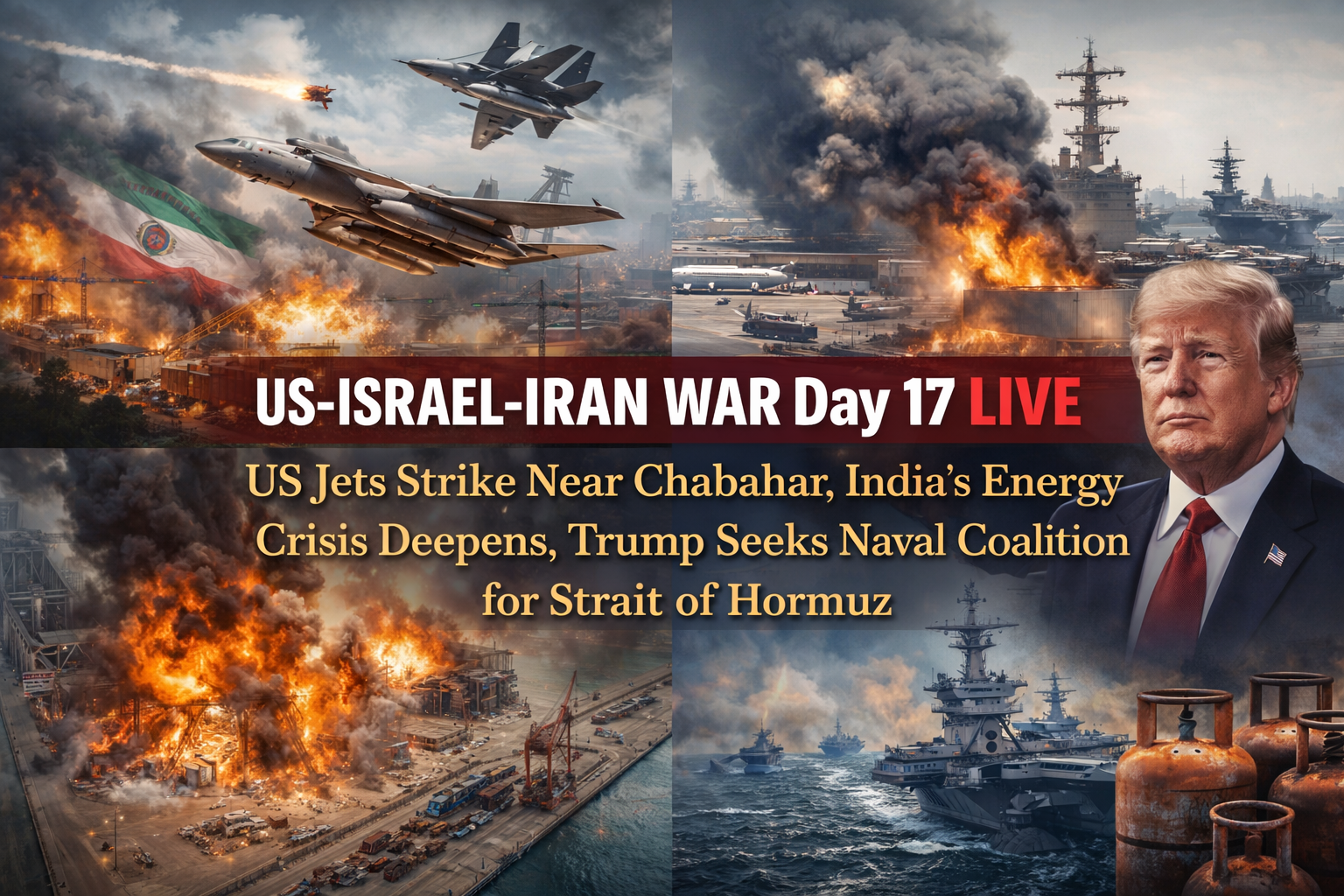
🔥 Dubai airport hit — drone strikes fuel tank, flights suspended temporarily
💥 Israel strikes 200+ targets in western & central Iran in past 24 hours
🛢️ Oil at $104+/barrel — IEA releases record 400 million barrels emergency reserve
🇮🇳 India’s energy crisis — 22 ships stranded, LPG panic buying, Indian Navy escorts two tankers
🌊 Trump demands 7 nations join Hormuz naval coalition — no firm commitments yet
☠️ Death toll: 1,444+ in Iran | 15 in Israel | 13 US soldiers | 19+ in Gulf states
📊 Iran fired: 700+ missiles and 3,600+ drones at US & Israeli targets since Feb 28
The US-Israel-Iran war, codenamed Operation Epic Fury, entered its 17th consecutive day on Monday, March 16, 2026, with no sign of de-escalation. The morning brought a fresh and significant escalation: US fighter jets struck military facilities near Iran’s Chabahar Free Trade Zone — a direct hit on a port region where India has invested over $500 million. Meanwhile, a drone struck a fuel tank at Dubai International Airport, temporarily shutting down the world’s busiest international airport. President Donald Trump is frantically assembling a naval coalition to reopen the Strait of Hormuz — but no nation has yet made a firm public commitment. And India, caught in the geopolitical crossfire, is facing its worst energy crisis in decades as LPG supplies run critically low for 333 million homes.
This post brings you all four major storylines of Day 17 in full detail — with sources, analysis, and what comes next.
- Day 17 Overview: What Has Happened So Far
- Story 1: US Jets Strike Near Iran’s Chabahar Port — What It Means
- Story 2: India’s Energy Crisis — Ships Stranded, LPG Shortage, The Geopolitical Trap
- Story 3: Trump’s Naval Coalition for Hormuz — Who Is Joining?
- War Scoreboard: Casualties, Targets, Missiles & Drones
- Regional Updates: Dubai, Baghdad, Lebanon, Saudi Arabia
- Background: How Did This War Start?
- Frequently Asked Questions
📅 Day 17 Overview: What Has Happened So Far on March 16, 2026
According to CNN’s Day 17 war tracker, the conflict that began on February 28, 2026 is now entering its third consecutive week with no diplomatic off-ramp in sight:
- US jets strike Chabahar — Military targets on mountains behind the Chabahar Free Trade Zone hit in early morning strikes. “Intense explosions” heard across the port city per Voice of America’s Persian Service.
- School hit in Khomein — A US-Israeli airstrike damaged the Shahid Khomeini Boys’ School in Khomein, Markazi province. No casualties reported; nearby homes damaged. Middle East Eye reports Iranian Red Crescent described it as an “airstrike on a school.”
- Dubai airport drone fire — A drone struck a fuel tank near Dubai International Airport, causing a fire and temporary suspension of all flights. An Emirates flight from Thiruvananthapuram with 353 passengers returned mid-air when Dubai closed. Limited Emirates schedule resumed after 10 AM.
- Israel announces limited ground operations in southern Lebanon — The IDF announced “limited targeted ground operations” in southern Lebanon, per Middle East Eye.
- Saudi Arabia intercepts 55 drones overnight — Saudi Arabia’s Ministry of Defence confirmed air defences intercepted and destroyed 55 drones in the Eastern Province.
- Japan says “has not heard anything” about coalition request — Japanese PM Sanae Takaichi told parliament that Tokyo had received no formal request from Washington about sending ships to Hormuz.
- Iraq explosion near Baghdad — An explosion in Nineveh, northern Iraq. Earlier, three people were injured in an airstrike on a Popular Mobilisation Forces base.
💥 Story 1: US Jets Strike Near Iran’s Chabahar Port — A Strategic Escalation
The most significant new development of Day 17 is the US military’s targeting of the area around Iran’s Chabahar Free Trade Zone in Sistan-Baluchestan province — near the Pakistan border and the Gulf of Oman.
NewsX reports that the United States launched a massive barrage of missiles targeting military facilities near the Chabahar port. Videos surfaced on social media showing US Air Force jets — including F/A-18 Super Hornets — hovering over the port city. The strikes hit military targets in the mountains behind the port town. According to Dawn’s live blog, Al Jazeera cited Voice of America’s Persian service confirming “intense explosions” were heard behind the Chabahar Free Trade Zone.
Why Chabahar Matters — Especially for India
Chabahar is not just any port. It is India’s single largest overseas strategic investment — a $500+ million bet on securing a land-and-sea corridor to Afghanistan and Central Asia bypassing Pakistan. India, through India Ports Global Ltd (IPGL), has invested approximately $120 million directly in the Shahid Beheshti terminal at Chabahar. Total Indian investment in the broader Chabahar ecosystem crosses $500 million.
| Aspect | Details |
|---|---|
| Location | Sistan-Baluchestan, Iran — Gulf of Oman, near Pakistan border |
| India’s direct investment | $120 million in Shahid Beheshti terminal via IPGL |
| Total ecosystem investment | $500+ million at risk |
| Strategic purpose | India’s gateway to Afghanistan & Central Asia; part of INSTC |
| US sanctions waiver | Expires April 26, 2026 — US declined to extend, per CRS Report |
| Chabahar-Zahedan railway | Due for completion in 2026 — now faces “indefinite delays,” says Chatham House |
| China threat | If India exits, China could integrate Chabahar into Belt and Road Initiative |
As strategic analyst C. Raja Mohan has warned: “Chabahar was not merely a port project. It was India’s strategic bridge to Eurasia.” The Chatham House researcher Chietigj Bajpaee noted that the Chabahar-Zahedan railway — a key component of the International North-South Transport Corridor (INSTC) linking India to Russia and Europe — will likely face indefinite delays. CNBC reports that the INSTC’s stalling may now accelerate India’s pivot to the IMEC (India-Middle East-Europe Economic Corridor) as its alternative connectivity strategy.
🇮🇳 Story 2: India’s Energy Crisis — Ships Stranded, LPG Panic, The Geopolitical Trap
CNBC’s comprehensive analysis captures India’s dilemma brutally: “While millions of barrels of oil flow to China via the Strait of Hormuz, India — Tehran’s old ally — is yet to secure a safe passage for its ships stuck in the critical waterway as New Delhi’s deepening ties with the US and Israel strain relations with Iran.”
The Energy Numbers
- India is the world’s 3rd-largest oil importer and 2nd-largest LPG consumer
- 40–50% of India’s crude oil and two-thirds of its LNG pass through the Strait of Hormuz
- As of March 14, 22 Indian-flagged vessels — 12 carrying critical energy supplies — were stranded near the Strait
- 88 lakh LPG panic bookings were registered in a single day, prompting government emergency intervention
- India invoked emergency powers directing refiners to maximise LPG production; cut supplies to industry to protect 333 million homes with LPG connections
- India’s March fertiliser tenders went unawarded — cargo ships refused to transit, threatening the upcoming sowing season
- OMCs suffering Rs 20/litre on petrol and Rs 45/litre on diesel — a combined Rs 2,000 crore daily loss
The Two Ships That Crossed — And What It Revealed
On March 14, in a carefully negotiated breakthrough, two Indian-flagged LPG tankers — the Nanda Devi LPG Carrier and the Shivalik LPG Carrier — successfully crossed the Strait of Hormuz under Indian Navy escort, carrying nearly 85,000 metric tonnes of LPG toward India. Sunday Guardian Live confirmed the Indian Navy escort and the 85,000 MT cargo.
But External Affairs Minister S. Jaishankar was quick to stress: the transit was not a “blanket arrangement” — it was a specific, diplomatically-negotiated exception. Iran’s ambassador to India Mohammad Fathali confirmed Tehran had allowed the Indian vessels to pass — a rare exemption to the blockade.
The Geopolitical Trap India Is Caught In
Free Press Journal’s deep analysis exposes the full complexity of India’s position. On March 11, EAM Jaishankar secured a “transit waiver” after a high-stakes phone call with Iranian FM Abbas Araghchi — but the waiver is only diplomatic, not military. Iran’s 31 independent IRGC provincial commands operating under the “Mosaic Doctrine” can act autonomously and may not honour Tehran’s central deal.
More alarming still: the same analysis reveals that China has emerged as the de facto custodian of Hormuz passage. The IRGC has explicitly signalled that Chinese vessels enjoy “Tier One” status — since February 28, nearly 11.7 million barrels have transited under IRGC protection because Beijing effectively funds the Iranian war machine. India, by contrast, is negotiating for “permissions” — a stark demonstration of how New Delhi’s US-Israel tilt has weakened its standing with Tehran.
🟢 Tier One: Chinese vessels — free passage, IRGC protection
🟡 Tier Two: Russian-affiliated vessels — generally safe
🟠 Tier Three: India — negotiated waiver, uncertain enforcement
🔴 Tier Four: Countries without agreement (e.g. Thailand) — transit at own peril
⛔ Blocked: US-flagged and Israeli-linked vessels — actively targeted
Adding another layer of complexity: CNBC reports New Delhi has reduced funding for Chabahar after the US declined to extend sanctions waivers for India’s operation of the port terminal beyond April 2026. India has also stopped purchasing Iranian crude following the collapse of the Iran nuclear deal under the first Trump administration. India’s opposition parties are now openly questioning whether the Modi government’s foreign policy alignment is compromising the nation’s energy security.
🌊 Story 3: Trump’s Naval Coalition for Hormuz — Who Is Actually Joining?
With global oil prices having surged from $71/barrel on February 27 to over $104/barrel by March 9 — and Iran’s new Supreme Leader Mojtaba Khamenei vowing to keep the Strait closed, with a Tehran official warning prices could hit $200/barrel — Trump has made reopening the Strait of Hormuz a top geopolitical priority.
What Trump Has Said and Done
Euronews confirmed that on Sunday, March 15, Trump told reporters aboard Air Force One that he has “demanded” approximately seven countries to join a naval coalition to police the Strait of Hormuz. He had previously named: China, France, Japan, South Korea, and the United Kingdom. Trump wrote on Truth Social: “Many Countries, especially those who are affected by Iran’s attempted closure of the Hormuz Strait, will be sending War Ships, in conjunction with the United States of America, to keep the Strait open and safe.”
Trump’s logic: according to UPI, the US gets only ~400,000 barrels/day through the Strait — a fraction of its needs. China, India, Japan and South Korea together account for 74% of crude oil shipments through the Strait. Trump argued the US is protecting it “almost like we do it for habit” for others’ benefit.
Axios revealed that Defence Secretary Pete Hegseth is sending the amphibious assault ship USS Tripoli and a Marine expeditionary unit to the region — capable of conducting ground operations if ordered. The US military also conducted a “large-scale precision” strike on Kharg Island — Iran’s oil export hub — destroying 90 military targets including naval mine storage, as a “shot across the bow” to signal Hormuz must reopen.
The Jerusalem Post reports the Trump administration plans to announce a formal coalition “as early as this week,” per the Wall Street Journal. The coalition is still deliberating whether to begin operations before or after the end of Iranian hostilities.
Country-by-Country Response Tracker
| Country | Status | Official Statement |
|---|---|---|
| 🇬🇧 United Kingdom | 🟡 Engaged | “Intensively looking” at options. PM Starmer discussed with Trump and Canada’s PM Carney. Al Jazeera |
| 🇫🇷 France | 🟠 Conditional | Working on “possible international mission” but only “when circumstances permit” — after fighting subsides. Al Jazeera |
| 🇩🇪 Germany | 🔴 Sceptical | FM Wadephul: “Sceptical.” “Will we soon be an active part of this conflict? No.” ARD Television. Al Jazeera |
| 🇯🇵 Japan | 🟡 Reviewing | PM Takaichi: “Has not heard anything” from Washington formally. Reviewing what is legally possible within Japan’s constitution. India TV News |
| 🇰🇷 South Korea | 🟡 Noting | “Takes note” of Trump’s call; will “closely coordinate and carefully review” with US. Euronews |
| 🇨🇳 China | 🟡 Diplomatic | Embassy spokesman: “All parties responsible to ensure stable energy supply.” Will “strengthen communication.” Euronews |
| 🇪🇺 EU | 🟡 Discussing | EU foreign policy chief Kallas: “In the interest of the EU to keep the Strait open” — discussing possible mandate change for Aspides Naval Mission. Middle East Eye |
| 🇮🇷 Iran’s response | ⚔️ Defiant | IRGC navy chief Tangsiri: “Let him send his ships.” FM Araghchi: Strait is open to non-US/Israeli ships; Iran in talks with countries seeking safe passage. Al Jazeera |
Can a Naval Coalition Actually Work?
Military analysts are deeply sceptical. Al Jazeera’s explainer cites King’s College London’s Andreas Krieg: “It doesn’t seem like they had a plan for the Strait of Hormuz to be closed, and it seems like a desperate move in an information campaign to calm markets.” Krieg warned that all Iran needed to do was strike occasionally to keep insurers away — and sending naval vessels without a diplomatic agreement would expose “very, very expensive military vessels to very cheap but potentially very effective projectiles.”
Maritime security expert Alexandru Hudisteanu, 13-year Romanian navy veteran, told Al Jazeera: “Interoperability is the biggest hurdle” — different doctrines, different communications, and all of this in what he called “a very unforgiving environment to sail with wartime missile threats, asymmetric mines or unmanned systems.” The full analysis is here →
📊 War Scoreboard: Casualties, Targets, Missiles & Drones (Day 17)
| Category | Data | Source |
|---|---|---|
| Iranian civilian deaths | 1,444+ | Al Jazeera tracker |
| Injured in Iran | 17,000+ | Al Jazeera Day 13 |
| Iranian military killed | 4,400+ (Hengaw, March 14) | Wikipedia war article |
| Displaced in Iran | 3.2 million (UNHCR) | Al Jazeera Day 13 |
| Israeli deaths | 15 | Al Jazeera tracker |
| US military deaths | 13 confirmed + 6 in refuelling crash | Al Jazeera tracker |
| US targets hit in Iran | 5,000+ (CENTCOM, March 10) | Al Jazeera tracker |
| Israel targets in past 24 hrs | 200+ in western & central Iran | Times of Israel, March 15 |
| Iranian missiles fired (total) | 700+ at US/Israeli targets | CNN Day 17 |
| Iranian drones fired (total) | 3,600+ at US/Israeli targets | CNN Day 17 |
| Iranian bases hit by IRGC | 27 US bases across the region | Al Jazeera tracker |
| Global oil price | $104+/barrel (up from $71 on Feb 27) | UPI |
| IEA emergency reserve release | 400 million barrels (record) | Al Jazeera March 11 |
| Ships stranded near Strait | 150+ anchored outside strait | Wikipedia Hormuz crisis |
| Crude tanker traffic drop | ~100% (effectively zero) | Wikipedia Hormuz crisis |
🗺️ Regional Updates: Dubai, Baghdad, Lebanon, Saudi Arabia (Day 17)
🇦🇪 UAE / Dubai
Dawn’s live blog confirms that a drone struck a fuel tank near Dubai International Airport, causing a fire. All flights were temporarily suspended. Dubai Police halted traffic on Airport Road and Airport Tunnel. An Emirates flight with 353 passengers from Thiruvananthapuram turned back mid-flight. A limited Emirates schedule resumed after 10 AM Monday. An Iranian missile also struck a civilian car in Abu Dhabi’s Al Bahyah area, killing a Palestinian national. The UAE air defences remained actively engaged intercepting Iranian missiles and drones.
🇮🇶 Iraq
An explosion was reported in Nineveh, northern Iraq. Three people were injured in an airstrike on a Popular Mobilisation Forces base. Iraqi security sources reported country air defences responding to drones near the US embassy in central Baghdad and the Balad airbase in Salah al-Din governorate.
🇱🇧 Lebanon
Israel announced “limited targeted ground operations” in southern Lebanon, per Middle East Eye. Israeli warplanes struck the city of Khiam three times. The Lebanese Government has banned Hezbollah’s military activities, but the group retains extensive weaponry. The UK House of Commons Library briefing notes Israeli attacks have killed 826 people and displaced more than 800,000 in Lebanon since the war began.
🇸🇦 Saudi Arabia
Saudi Arabia’s Ministry of Defence confirmed air defences intercepted and destroyed 55 drones overnight in the Eastern Province, plus 3 over Riyadh. The ministry stated “all hostile targets were destroyed.” A total of at least 2 people have been killed and 12 injured in Saudi Arabia since Iran began retaliatory attacks.
🇮🇱 Israel
Times of Israel reports the IDF says it “still has thousands of targets to hit in Iran, with new ones identified every day.” The Israeli Air Force has struck over 2,000 total targets across Iran during the war, using over 10,000 munitions. Israel claims it has taken out more than 70% of Iran’s ballistic missile launchers. Sirens blared in central Israel on Sunday as Iran launched multiple missile barrages. Iran’s new Supreme Leader Mojtaba Khamenei’s whereabouts remain unconfirmed — US Defence Secretary Hegseth claims he is “wounded and likely disfigured.” Iran’s FM denies this, saying he is “in excellent health.”
📖 Background: How Did This War Start?
The conflict — codenamed Operation Epic Fury by Israel and Operation Roaring Lion by Israel’s Air Force — began with a joint US-Israeli surprise strike on February 28, 2026, coinciding with the first day of Ramadan 2026.
Wikipedia’s comprehensive 2026 Iran war article documents the key triggers:
- Failed nuclear negotiations — Indirect talks in Oman’s mediation collapsed in February 2026. Trump said he was “not thrilled” with Iran’s concessions.
- 2025–2026 Iranian protests — Iranian security forces killed thousands of protesters in January 2026, sparking international outrage and Trump threats.
- Prior 12-day war in 2025 — A prior US-Israeli strike campaign in June 2025 had already targeted Iran’s nuclear facilities.
- Supreme Leader Khamenei assassinated — Ali Khamenei was killed on February 28 in the opening strike on his compound. His daughter, son-in-law, and other family members were also killed. His son Mojtaba Khamenei was elected the new Supreme Leader on March 8, 2026.
The UK House of Commons Library’s official briefing on the conflict states the strikes were aimed at “inducing regime change in Iran and targeting its nuclear and ballistic missile programme.” The International Institute for Strategic Studies (IISS) has published an assessment of the campaign’s regional implications, available at iiss.org.
❓ Frequently Asked Questions — US-Israel-Iran War Day 17
What happened on Day 17 of the Iran war?
On Day 17 (March 16, 2026), the major developments were: US jets struck military targets near Iran’s Chabahar Free Trade Zone; a drone hit a fuel tank at Dubai International Airport temporarily closing it; Israel announced limited ground operations in southern Lebanon; Saudi Arabia shot down 55 overnight drones; and Trump demanded 7 nations join a Hormuz naval coalition, with no firm commitments received. Full CNN Day 17 tracker →
Why did the US strike near Chabahar port?
US jets targeted military facilities on mountains behind the Chabahar Free Trade Zone in Iran’s Sistan-Baluchestan province. The strikes targeted Iranian military installations, not the port itself. However, the proximity to India’s $500M+ strategic port investment has major geopolitical implications. NewsX full report →
Why is India facing an energy crisis because of the Iran war?
Iran’s closure of the Strait of Hormuz since March 4 has effectively blocked the passage through which 40–50% of India’s crude oil and two-thirds of its LNG pass. India has 22 flagged vessels stranded near the Strait and is facing panic LPG buying for 333 million homes. India’s US-Israel tilt has weakened its ability to secure blanket safe passage from Tehran. Full CNBC analysis →
Is anyone joining Trump’s Hormuz naval coalition?
As of March 16, no country has made a firm public commitment. The UK is “intensively looking,” France is conditional on hostilities subsiding, Germany is sceptical, Japan says it has “not heard” formally, South Korea is “reviewing,” and China is offering diplomatic platitudes. The Trump administration expects to announce a formal coalition “as early as this week,” per the Wall Street Journal. Al Jazeera analysis →
What is Iran’s Chabahar port and why does it matter to India?
Chabahar is a deep-water port on Iran’s Gulf of Oman coast, developed by India as its strategic gateway to Afghanistan and Central Asia bypassing Pakistan. India has invested $120 million directly in the Shahid Beheshti terminal and $500+ million in the wider ecosystem. The US sanctions waiver allowing India to operate it expires April 26, 2026. If India loses it, China could absorb it into the Belt and Road Initiative. IBTimes India strategic analysis →
How much oil passes through the Strait of Hormuz?
Approximately 20% of the world’s daily oil supply and significant LNG volumes pass through the Strait. It is 21 nautical miles wide at its narrowest point. The Strait carries roughly 27% of the world’s maritime trade in crude oil and petroleum products. Since its effective closure on March 4, tanker traffic has dropped to near-zero. Wikipedia Hormuz crisis article →
✈️ Dubai airport drone hit — flights suspended, Emirates partial schedule resumes
🌊 Trump demands 7-nation Hormuz coalition — WSJ: announcement coming this week
🇮🇳 India: 22 ships stranded | 2 tankers through | energy emergency declared
📊 Iran: 700+ missiles, 3,600+ drones fired | 1,444+ civilians dead | 3.2M displaced
🛢️ Oil: $104+/barrel | IEA: 400M barrel emergency release
🔔 Bookmark this page — we update as events develop.
Leave a Reply